
Red light therapy during pregnancy
Anyone who is pregnant and already has a panel or mask at home will sooner or later arrive at the same question: can I simply continue using it? “Red light therapy pregnancy” is a search query with a clear underlying concern. Not curiosity, but a need for certainty. We cannot give you that certainty, and that is the most honest thing to say about it. What this article does provide is an overview of what is known, what is not known, what practical distinction seems useful, and why your midwife or gynecologist has the final say.
The honest answer upfront
There is no research describing harm caused by red light therapy during pregnancy. However, very little research has been conducted involving pregnant women. Absence of evidence is not evidence of safety. Our advice is therefore cautious: consult your midwife or gynecologist first, and follow their judgment above anything stated here.
That paragraph is the article in brief. The rest provides context for the conversation with the person who knows your medical history.
Why there is hardly any research involving pregnant women
Pregnant women are almost never included in scientific studies. As long as a risk to the unborn baby cannot be ruled out, that unknown risk weighs more heavily for ethics committees than the benefit of the study. As a result, the evidence base remains limited, from medication to physical applications.
That applies to photobiomodulation. The mechanism is reasonably well described and has been studied, among others, at Harvard Medical School and NASA: cytochrome c oxidase in the mitochondria absorbs 660nm and near-infrared light from 830 to 850nm, nitric oxide is released, and ATP production accelerates. This process is explained on the pillar page about how red and near-infrared light works, with broader supporting evidence in our overview of scientific research on red light therapy. What is missing from that literature is pregnant women. No study answers the question of whether RLT is safe during pregnancy, in either direction.
One thing is clear, without this being a guarantee: red and near-infrared light contains no UV or ionizing radiation. The points to consider are therefore penetration depth and heat, not radiation damage.
Red light therapy during pregnancy: which areas to distinguish
Most people are not looking for a general yes or no, but for a practical distinction. That distinction is based on the distance from the uterus. The face, neck and scalp are far away from it. Near-infrared light penetrates approximately 4 to 5cm, while 660nm reaches only around 5 to 10mm. Light on your forehead does not come near the uterus. Light on your abdomen is a different matter.
| Area | Distance from the uterus | Our advice during pregnancy |
|---|---|---|
| Face, neck and scalp | Large | Discuss beforehand. Take extra care in case of melasma |
| Shoulders, upper back, neck | Large | Discuss beforehand. Pay attention to heat buildup |
| Forearms, hands, lower legs, feet | Large | Discuss beforehand |
| Breast tissue and décolleté | Not applicable | Do not illuminate without consultation |
| Abdomen and flanks | Directly | Do not illuminate |
| Lower back, pelvis, sacrum | Directly | Do not illuminate |
| Whole body in one session | Directly | Do not use during pregnancy |
Pay attention to what is stated here and what is not. “Discuss it beforehand” is not a disguised green light: the decision lies with your healthcare provider.
The abdomen and lower back: do not illuminate
We advise against illuminating the abdomen and lower back during pregnancy. No research describing harm is needed for this; it is sufficient that safety has not been established anywhere, while near-infrared light penetrates several centimeters deep in these areas.
That addresses exactly what many pregnant people are thinking about. Lower back pain and pelvic instability are among the most common complaints in the second and third trimesters, and that is precisely the area to avoid. What you read in our article about red light therapy for back pain does not apply during pregnancy, and using a belt around the lower back is not appropriate now. For this, see a midwife or pelvic physiotherapist; light does not replace that guidance.

Heat and overheating
Some of the energy from a session is converted into heat in the skin. With a panel at 15 to 30cm, this feels like mild warmth, comparable to sunlight through a window. During pregnancy, heat carries more weight because an elevated core temperature in early pregnancy is considered a risk factor in the literature. That is why pregnant people are advised to be cautious with saunas and hot baths.
A local session on the face is not a sauna: the warming is superficial and local. Nevertheless, we do not know of a figure that would allow us to reassure you. In practice:
- Avoid full-body sessions: they also expose the abdomen to light.
- Keep sessions short. Ten to fifteen minutes per area is standard; shorter is wiser for now.
- Keep your distance: at 25 to 30cm, the heat load is lower than at 15cm.
- Stop if you experience unpleasant warmth, dizziness, or light-headedness, and report it to your midwife.
- Do not combine a session with a hot bath or intense exercise.
Pregnancy mask: be cautious with the face
The face in particular, the area farthest from the uterus, still calls for further consideration. Melasma, commonly known as the pregnancy mask, is the brownish pigmentation that develops on the forehead, cheeks, or upper lip in many women. Hormones make pigment cells more sensitive, and light is a known trigger.
That mechanism has been best described for UV and blue light. For red light, the picture is less clear, although there are indications that visible light outside the UV spectrum can also affect melasma in sensitive skin. We do not know where 660nm fits into this. We do know that melasma can be unpredictable and difficult to reverse. If you have it now or had it during a previous pregnancy, discuss it with your midwife, GP, or dermatologist before exposing your face to light. What red light does to non-pregnant skin is discussed in our articles on red light therapy for the skin and red light therapy for acne.
Red light therapy during pregnancy and the LED mask
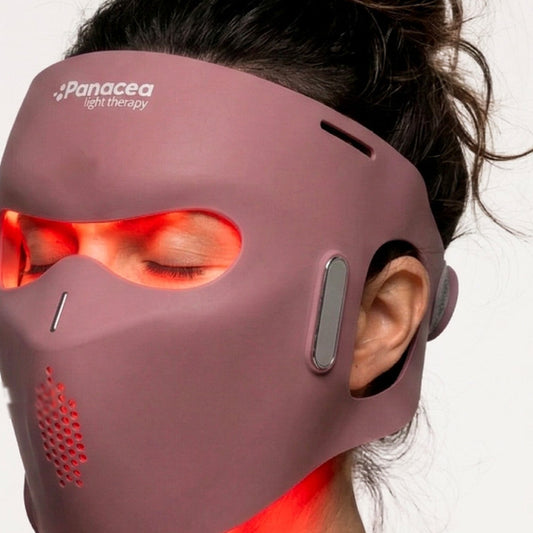
Using an LED mask during pregnancy is the most frequently asked version of this question. Understandably: many women are now specifically looking for care without active ingredients, because retinoids and some acids are no longer suitable. A Panacea LED mask may then seem like a passive choice. Background information is available on the page about the Panacea LED mask.
There is no automatic approval here either. What we can say is that the mask exposes only the face and neck, the abdomen remains out of reach, and there is no UV involved. What we cannot say is that this makes it safe. That statement requires research that does not exist. With the version featuring décolleté, breast tissue is also exposed.
If you are unsure about your own situation, you can schedule a free fifteen-minute video call with a specialist, without a sales pitch. We do not provide a medical opinion during it and will refer you back to your midwife, but we can explain what a device does and what you can take into account. If you would rather leave a question below, a person will always read it: comments are answered by a person within 24 hours.

Red light and breastfeeding
Red light and breastfeeding are different, although the evidence base remains limited. We are not aware of any indications that exposing the face, scalp, or limbs causes problems during this period. The light works locally and no substance enters breast milk.
Two caveats. Do not expose breast tissue itself without consulting your midwife, general practitioner, or lactation consultant, especially in the case of engorgement, cracked nipples, a blocked milk duct, or signs of mastitis: those symptoms should be assessed first. Also bear in mind that the breasts and décolleté are often included in a single movement during a facial session. Make that choice consciously.
Consult your midwife or obstetrician
This article does not give permission or prohibit anything, but provides arguments for a good conversation. Consider the following:
- Which device you have, which wavelengths it uses (with us, 660nm and 830 to 850nm), and which area you want to expose.
- The power at the exposed area. Panacea panels measure a calibrated 130 to 200 mW/cm² at 15cm; an LED mask is well below that. That figure says more than the brand name.
- The duration and frequency you have in mind.
- Your medical history: melasma, medication that makes the skin more sensitive to light, and the course of this and previous pregnancies.
If you don't get a clear answer, postponing is the safest option. Red light does not work with an immediate effect; it builds gradually: with regular use, the body builds capacity over several weeks, and results vary from person to person. You won't miss anything by waiting.
Frequently asked questions
Is red light therapy safe during pregnancy?
That has not been established. There is no research describing harm, but there is also very little research involving pregnant women, because they are almost never included in studies. Absence of evidence is not evidence of safety. Our cautious advice is to consult your midwife or obstetrician first and follow their judgment.
May I use an LED mask if I am pregnant?
The face is far from the uterus, and a mask contains no UV, so this differs from exposing the abdomen. However, we cannot base a safety statement on that. Discuss it with your midwife, especially if you have melasma or previously developed a pregnancy mask, and keep sessions short.
May I expose my abdomen or lower back to light during pregnancy?
No, we do not recommend that. Near-infrared light penetrates 4 to 5cm, and those areas lie directly above the uterus. There is no research supporting exposure there. For back problems or pelvic pain during pregnancy, a midwife or pelvic floor physiotherapist is the appropriate resource.
Can red light therapy be harmful during breastfeeding?
We are not aware of any indications that exposing the face, scalp, or limbs causes problems during breastfeeding. The light works locally, and no substance enters breast milk. Do not expose breast tissue itself without consulting a healthcare professional, and have engorgement, cracked nipples, or signs of inflammation assessed medically first.
I used red light before I knew I was pregnant. What now?
There is no research describing harm after exposure, so there is no reason to assume the worst. However, we cannot reassure you based on data that does not exist. Mention it at your next appointment with your midwife and postpone use until then.
Would you like to know what red light therapy after pregnancy can do for your skin? Take a look at the Panacea LED mask, or discuss your situation in a free video consultation. If your question is not listed here, see the frequently asked questions.
Red light therapy is a wellness application and not a substitute for medical care. Results vary from person to person; consult your doctor if you have any concerns.