
Red light therapy for the skin
There are exaggerated promises and strong skepticism surrounding red light therapy for the skin. Red light has a measurable effect in the dermis, but slowly, and only with sufficient intensity and repetition. Below is everything related to red light therapy for the skin: the three skin layers, fibroblasts, collagen and elastin, why 660nm may be effective, what near-infrared adds, a realistic timeline, and a protocol for the face.
What red light therapy does to the skin
Red light therapy for the skin works through photobiomodulation: light of around 660 nanometers reaches the dermis, where it is absorbed by mitochondria. As a result, the cell produces more ATP, and fibroblasts gain the energy to produce collagen and elastin. A visible difference requires weeks to months of consistent use, and results vary from person to person.
The mitochondrion's electron transport chain contains cytochrome c oxidase, an enzyme that is sensitive to red and near-infrared light. When exposed to light, nitric oxide is released, ATP production speeds up, and brief bursts of reactive oxygen act as a repair signal. This mechanism has been studied at Harvard Medical School and by NASA, among others, and is explained in detail on our pillar page on how red and near-infrared light work and in our overview of scientific research into red light therapy.
There is already a shorter piece about the benefits of red light for the skin. This article is the complete guide and goes one layer deeper.
The three skin layers and where the light reaches
You only understand red light skin rejuvenation once you know which layer you are targeting. The skin consists of three layers:
- The epidermis, 0.05 to 1.5 millimeters. The barrier that determines how smooth and even your skin looks. Skincare products work mainly here.
- The dermis, 1 to 4 millimeters. This is where the fibroblasts, collagen and elastin network, and capillaries are located. Firmness, resilience, and the depth of lines originate here. This is the layer targeted by LED light therapy for the face.
- The subcutaneous layer (subcutis), the subcutaneous connective tissue and the larger blood vessels beneath it. This layer is beyond the reach of a cream.
Most skincare routines do not go beyond the epidermis. Anyone who wants to address the structure beneath it must actually reach that layer.
Fibroblasts, collagen and elastin
Fibroblasts are the builders of the dermis. They produce collagen for structure and firmness, and elastin that allows the skin to spring back. Over the years, this production slows while breakdown continues. From around age 25, collagen production declines by roughly 1 percent per year. In the first five years after menopause, the loss can reach 30 percent.
In practice, stimulating collagen means giving fibroblasts more energy and a clearer repair signal. Studies using skin biopsies found increased collagen production after several weeks of daily use. To be honest, these are tissue measurements, not a promise of what you will see in the mirror. This research is usually small in scale, and differences between people are substantial.
Why 660nm reaches the dermis
How deeply light penetrates depends on the wavelength. Red light at 660nm reaches approximately 5 to 10 millimeters deep. At 1 to 4 millimeters, the dermis is well within that range. Shorter wavelengths, such as blue light, remain in the epidermis and do not reach the fibroblasts.
Depth alone is not enough; sufficient light must also reach the skin. For an effect considered relevant in research, a minimum of approximately 100 mW/cm² at the illuminated area is used. Cheap devices often reach only 20 to 30 mW/cm². Panacea panels measure a calibrated 130 to 200 mW/cm² at 15 centimeters. Why these figures are often misleading is explained in our article on LED masks and light intensity in mW/cm².
A third factor is wavelength purity. A diode that promises 660nm but emits 640nm misses the absorption peak of cytochrome c oxidase. Our diodes stay within 5nm of the target value and are supplied with spectral reports.
What near-infrared adds
Near-infrared light from 830 to 850nm penetrates 4 to 5 centimeters, beyond the dermis. For the skin, this is not a replacement for 660nm but a complement: it reaches the blood vessels and underlying connective tissue, where microcirculation gets underway. Research has shown that macrophages shift into a reparative mode in response.
What we will not claim is that more wavelengths are automatically better. A device with eight colors on the box is not necessarily more effective than a device that delivers two well-researched wavelengths cleanly. That combination is the basis of the Panacea LED mask.

Red light therapy for the skin: what to expect with regular use
The question is always when something will become visible. The honest answer: later than you hope.
| Period | What happens in the skin | What you notice |
|---|---|---|
| Early stage | More ATP, fibroblasts become active, new collagen is still immature | Nothing visible yet, sometimes a hydrated feeling |
| With regular use | Initial maturation of new collagen, improved microcirculation | Finer texture, more even-looking skin |
| After several weeks to months | The collagen and elastin network is measurably replenished | Many users notice changes in firmness and fine lines |
| In the longer term | Slow restructuring of older tissue | Changes in scar tissue and pigment distribution |
The key sentence of this article: red light does not work like a cream with an immediate effect; it builds over time. In the first weeks, the skin builds capacity, and only afterward do many users notice a difference. If you stop after three weeks because there is nothing to see, you are left with nothing.
The protocol for the face
A protocol you can stick to works better than a perfect protocol you abandon. The basic principles:
- Frequency. Five to six times per week is optimal; three times per week is the minimum. Twice a week does not deliver results.
- Duration. Ten to fifteen minutes per area, with five to seven minutes during the first week.
- Distance from a panel. Fifteen to thirty centimeters, with thirty centimeters for the first two weeks. A mask rests on the skin and does not require this consideration.
- Bare, clean skin. Makeup and thick creams reflect or absorb light. Apply your skincare after the session.
- Eyes. Closing your eyes is sufficient, and goggles are included. Red light is not UV, but it is too bright to look at directly.
- Timing. Red light does not suppress melatonin, unlike blue light. An evening session therefore does not disrupt sleep.
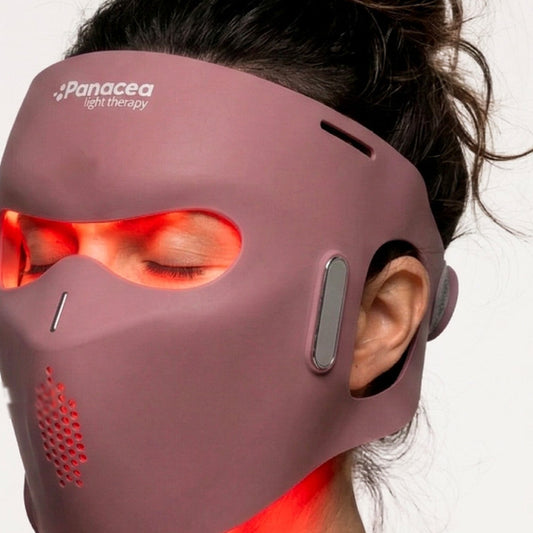
For the face, a mask is usually more practical: the distance is fixed. If you want to include your neck and décolleté, the Panacea LED mask for face and décolleté is the logical choice. The comparison is in the LED mask guide. If you also illuminate larger areas, the ATP Pro 700 for half the body is more versatile.
Red light therapy for the skin alongside your skincare routine
Does light replace your products? No. Red light therapy for the skin is an addition, not a replacement. Your routine cares for the barrier: cleansing, moisturizing, and above all daily sun protection, still one of the most influential factors for your skin in the long term. Light works one layer deeper, on the fibroblasts. If you stop using sun protection because there is a mask in the drawer, you will ultimately be worse off.
Practical: use the light on clean skin and apply serums and creams afterward. If you use retinol, vitamin C, or acids, there is no indication that red light conflicts with them, but irritated skin needs time to rest. If you use medication that makes the skin photosensitive, or are undergoing treatment for a skin condition, consult your doctor first. Light therapy does not replace a healthcare professional.
Special situations
For blemished skin, different considerations apply than for skin rejuvenation: you can read about them in red light therapy for acne. If you are pregnant or breastfeeding, first see red light therapy during pregnancy, where we also mention what has not yet been researched.

If you cannot decide which device suits your skin, you can schedule a free fifteen-minute video call with a specialist. No sales pitch, just a discussion of your situation. Prefer to ask a question here? A human always reads the comments below this article, and replies are answered within 24 hours.
Frequently asked questions
How long does it take to see results on the skin?
Expect several weeks to months of regular use with five to six sessions per week. At first, you usually will not see anything yet, because new collagen still needs time to mature. After a few weeks, users often report a finer texture. Scars and pigmentation usually take longer. Results vary from person to person.
Does an LED mask work better than a panel for the face?
For the face, a mask is more practical: the distance to the skin is fixed and you can continue moving. A panel is more versatile because you can also use it on your back, knees, or shoulders. The active factor is not the form, but the wavelength and the intensity on the skin.
Can you combine red light therapy with retinol or vitamin C?
There is no evidence that red light conflicts with retinol, vitamin C, or acids. Use it on clean skin and apply your products after the session. If your skin is irritated, take it easy. If you take medication that causes photosensitivity, consult your doctor first.
How often per week should you expose your face to light?
Five to six times per week generally delivers the greatest effect. Three times per week is the minimum at which an effect can be expected. Twice per week does not produce results according to current insights. Ten to fifteen minutes per session is sufficient; during the first week, five to seven minutes.
Is red light therapy for the skin safe for the eyes?
Red and near-infrared light contains no UV and is not the same as sunlight. However, the intensity is too high to look at comfortably. Closing your eyes is sufficient during a facial session, and our devices come with protective glasses. If you have an eye condition, consult your ophthalmologist beforehand.
If you want to get started with LED light therapy for the face, take a look at the Panacea LED mask with 660nm and near-infrared. If you are still unsure, you can find more information on our frequently asked questions page, or schedule that conversation.
Red light therapy is a wellness application and not a substitute for medical care. Results vary from person to person; consult your doctor if you have symptoms.