
Red light therapy versus tanning bed: what is the difference?
From a distance, they look similar: you enter a cabin or stand in front of a panel, the light comes on, and you come out after fifteen minutes. Yet comparing red light therapy with a tanning bed is about as useful as putting an oven next to a refrigerator because both have a door. The difference lies not in the shape of the device but in the wavelength, which determines whether the light builds up or breaks down your skin. Below, you will read exactly where that difference lies, why red light does not tan, and whether it can still benefit you after a day in the sun.
Why people confuse them
The confusion is understandable. Both involve light on bare skin, both use 15-minute sessions, and both take place in a room filled with lamps. Moreover, red light therapy is known professionally as photobiomodulation or LED therapy, and the word "therapy" reinforces the idea that they are variations of the same thing.
That is not the case. The visible spectrum runs from violet to red. Just beyond violet lies UV radiation: short-wave and high-energy. Just beyond red lies near-infrared: long-wave and low-energy. A tanning bed works on the high-energy side, while red light therapy works on the gentler side. They occupy opposite ends.
Red light therapy vs tanning bed: the comparison
In short: a tanning bed emits UVA and UVB and tans the skin through pigment production, with known long-term damage. Red light therapy uses 660nm and near-infrared light from 830 to 850nm, contains no UV, does not tan, and instead stimulates collagen production. The difference between a tanning bed and LED is therefore not a matter of degree but a complete contrast.
| Characteristic | Tanning bed | Red light and near-infrared |
|---|---|---|
| Wavelength | UVA approximately 315 to 400nm, UVB approximately 280 to 315nm | 660nm (red) and 830 to 850nm (near-infrared) |
| Contains UV | Yes, that is the active principle | No, no UV component at all |
| Depth of penetration | UVB almost exclusively affects the epidermis, while UVA reaches into the upper dermis | 660nm: 5 to 10mm. 830 to 850nm: 4 to 5cm |
| What it does to the skin | Stimulates melanocytes to produce pigment, causing a stress response in the skin | Absorbed by mitochondria, increasing ATP production in skin cells |
| Effect on collagen | UVA breaks down collagen and elastin through enzymes | Studies observed increased collagen production by fibroblasts |
| Long-term skin damage | Recognized risk of premature aging, pigmentation spots, and permanent skin damage | No evidence of cumulative skin damage with normal use |
| Tanning | Yes, that is the goal | No, and that is precisely the point |
| Session duration | Typically built up from a few minutes to 15 minutes, with mandatory rest days | 10 to 15 minutes per area, 5 to 7 minutes during the first week, 5 to 6 times per week |
| Eye protection | Required; UV damages the cornea and lens | Not strictly necessary; goggles are included |
What UV does to the skin
UV carries enough energy to act directly on the DNA in skin cells. UVB is almost entirely absorbed by the epidermis, where it causes the burn you see as redness. UVA penetrates deeper, into the upper layers of the dermis, and that is where the problem lies.
The dermis contains fibroblasts, the cells that produce collagen and elastin. UVA activates enzymes that break down that collagen and damages the fibers that give the skin its firmness. The long-term result is called photoaging: leathery texture, loss of elasticity, age spots, and fine lines. UV is also recognized as a risk factor for permanent skin damage, including from a device.
Tanning itself is a protective response. Melanocytes produce pigment because the skin signals that damage is imminent. Biologically speaking, a tan is therefore visible evidence that the skin has had to deal with something.
What red light and near-infrared light do to the skin
Red light at 660nm and near-infrared light at 830 to 850nm act elsewhere. They are absorbed by cytochrome c oxidase, an enzyme in the mitochondrial electron transport chain. During exposure, nitric oxide is released, ATP production speeds up, and brief bursts of reactive oxygen species act as a repair signal. This process is called photobiomodulation and has been studied at institutions including Harvard Medical School and NASA. The pillar page about how red and near-infrared light works explains it step by step.
For the skin, that means the opposite of UVA. Fibroblasts receive more energy for their work: studies using skin biopsies showed increased collagen production with regular use over several weeks. That matters because collagen stores decline by about 1% per year from around age 25 and can decrease by up to 30% in the first five years after menopause. Read more in the article about red light therapy for the skin, and for inflamed skin, see the article about red light therapy for acne.
To be clear: red light does not work like a switch; it builds gradually. In the first few weeks, the body builds capacity, after which an effect may become noticeable. Anyone who stops too soon will get little out of it. For the skin, regular use over several weeks may make the texture feel smoother, while changes in scars and pigmentation generally require even more patience, often months. Results vary from person to person.

Red light therapy vs. tanning bed: why red light does not cause tanning
This is the most frequently asked question in this comparison, and the straightforward answer is: no, it will not make you tan. Red light contains no UV, so melanocytes receive no stimulus to produce pigment. Some people see a slight flush immediately after a session, but that is increased blood flow, not tanning, and it fades within half an hour.
So red light is not an alternative for anyone looking to get a tan. For anyone wanting to improve skin quality, that is precisely why they should choose it: the constructive side of light without the destructive side. This also makes it useful for people with fair skin, many pigmented spots, or a reason to avoid UV. If you use medication that makes your skin photosensitive, consult your doctor or pharmacist first.
Does red light produce vitamin D
No. Vitamin D production in the skin specifically requires UVB, radiation around 290 to 315 nm. Red light and near-infrared light are hundreds of nanometers away from that range and cannot trigger this reaction. If you suspect a deficiency, have it assessed through blood tests and discuss supplementation or safe sun exposure with your doctor.
It is one of the few things that UV light does and red light does not. At the same time, health authorities generally prefer supplementation over UV exposure: vitamin D can be obtained elsewhere, while skin damage cannot be reversed.
Red light after using a tanning bed or after a day in the sun
Yes, and many people do it precisely for that reason. Red light and near-infrared light support recovery processes: microcirculation improves and macrophages shift from a pro-inflammatory to a restorative mode. Users report that overheated, tight skin feels calmer after a session. A few practical points:
- If your skin is sunburned, wait until the acute redness and heat have subsided. Do not expose open blisters to the light.
- Keep the first sessions short, 5 to 7 minutes, at a distance of 30 cm.
- Use on clean, dry skin, without after-sun lotion or oil during the session. Apply skincare afterward.
- Do not take it as permission to use UV more often.
The latter deserves emphasis. There is no research showing that red light reverses UV damage. What the research suggests is that it supports repair processes in tissue. That is different from a reset.
Eye protection: mandatory or not
Here, the two differ fundamentally once again. With a tanning bed, UV goggles are mandatory, without exception. UV damages the cornea and contributes to cataracts, and closed eyelids do not block enough UV. There, goggles are not a comfort choice but a necessity.
Red light therapy is different. There is no UV, and there is no evidence that red or near-infrared light at this intensity damages the eyes. Strictly speaking, goggles are therefore not necessary. However, it is uncomfortable: at 15 to 30cm from a panel, the light intensity is high and you will instinctively squint. That is why goggles are included with our panels. Closing your eyes works too. Anyone with an eye condition or taking light-sensitizing medication should consult an ophthalmologist beforehand.
If you are unsure whether this is right for your situation, you can schedule a free fifteen-minute video call with a specialist, with no sales pitch. Leave a question below and a real person will always read it: comments are answered by a person within 24 hours.

Which device suits which purpose
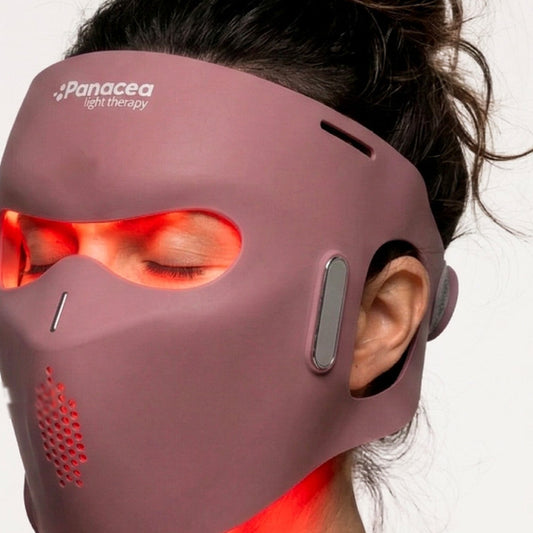
Those who say goodbye to the tanning bed and are looking for something for their skin usually end up choosing a panel or a mask. The ATP Pro 700 red light therapy panel is the most versatile choice: large enough for half the body, including the face and décolleté, but equally suitable for the back, knees, or shoulders. If you are only concerned with the face, the Panacea LED mask is more practical because the distance remains constant automatically.
One figure determines whether a session is worthwhile: irradiance, the power that actually reaches the skin. Research generally uses a minimum of approximately 100 mW/cm². Cheap devices often reach only 20 to 30 mW/cm². Panacea panels measure a calibrated 130 to 200 mW/cm² at 15cm, with diodes that stay within 5nm of the target value. Below that threshold, you can expose yourself faithfully for months without seeing results. The evidence is compiled on the page about scientific research into red light therapy.
If red light is more often confused with heat than with UV, the comparison with an infrared sauna is at least as illuminating: the distinction there is between heat and wavelength.
Frequently asked questions
Is red light therapy the same as a tanning bed
No. A tanning bed uses UVA and UVB, radiation that produces pigment and breaks down collagen over time. Red light therapy uses 660nm and near-infrared light from 830 to 850nm, at the other end of the visible spectrum. It contains no UV, so it will not tan you, and collagen is not broken down but rather stimulated.
Will red light therapy make me tan
No. Tanning occurs because melanocytes produce pigment in response to UV, and red light contains no UV. Immediately after a session, the skin may flush slightly due to improved circulation, but the flush fades within half an hour. If you are looking for a tan, you will not find it here, and that is precisely the point of this type of light.
Does red light therapy produce vitamin D
No, UVB is required for that, specifically radiation around 290 to 315nm. Red light and near-infrared light are hundreds of nanometers farther away and cannot trigger that reaction. If you suspect a deficiency, have a blood test and discuss supplementation with your GP. This is one of the few things UV does that red light does not.
Can I use red light after using a tanning bed or spending a day in the sun
It can. Red and near-infrared light support tissue recovery processes: microcirculation improves and immune cells shift into a restorative mode. If your skin is sunburned, wait until the acute heat and redness have subsided, keep the first sessions short, and do not expose open blisters. It does not undo UV damage.
Do I need glasses for red light therapy
With a tanning bed, UV-protective glasses are mandatory because UV damages the cornea. Red light contains no UV, so glasses are not strictly necessary. At close range, however, the light is bright and uncomfortable, which is why glasses are included. You can also close your eyes. If you have an eye condition, consult your ophthalmologist beforehand.
Would you like to calmly explore what UV-free light can do for your skin? View the ATP Pro 700 panel, or discuss your situation in the free video consultation. If your question is not listed here, see the frequently asked questions.
Red light therapy is a wellness application and not a replacement for medical care. Results vary from person to person; consult your doctor if you have any complaints.