
Red light therapy for acne and skin problems
Acne is rarely a matter of washing poorly. It is an interplay of sebum, keratinized skin cells, bacteria, and inflammation—and it is that final link that determines how red and painful a breakout becomes. People searching for red light therapy for acne are usually looking for something gentler than a prescription treatment: an approach that calms the skin instead of drying it out further. In this guide, you will learn what red light therapy can and cannot mean for acne, why blue light targets a different mechanism, and what a realistic protocol looks like.
How acne develops: four links
A pimple is the endpoint of a chain of events. Understanding the links also explains why light targets one point in that chain but has no effect elsewhere.
- Sebum production. The sebaceous glands are influenced by hormones, particularly androgens. This factor plays the strongest role during puberty and around the menstrual cycle.
- Hyperkeratinization. The cells in the hair follicle wall do not shed properly but stick together. The pore becomes clogged, forming a comedo, or blackhead.
- Bacteria. In the blocked, sebum-rich pore, Cutibacterium acnes has room to thrive. This bacterium is part of normal skin, but here the balance shifts.
- Inflammation. The immune system responds: the pore becomes red, swollen, and sensitive. This response determines whether you have an inconspicuous blackhead or a painful bump that remains for weeks and leaves a mark.
Acne is therefore not a hygiene problem. Overly aggressive cleansing damages the skin barrier, after which the skin often produces even more sebum.
Red light therapy for acne: what it does
Red light therapy for acne targets the inflammatory component and recovery after a breakout, not sebum production or the hormones behind it. 660nm and near-infrared light from 830 to 850nm are absorbed by the mitochondria in skin cells, which then have more energy for calming inflammation and tissue repair.
The mechanism is called photobiomodulation. Cytochrome c oxidase, an enzyme in the mitochondrial electron transport chain, is sensitive to red and near-infrared light. When exposed, nitric oxide is released, ATP production accelerates, and brief bursts of reactive oxygen species act as a repair signal. The process is explained step by step on the pillar page about how red and near-infrared light works, based on research conducted at institutions including Harvard Medical School and NASA.
Two effects are relevant for inflamed skin. Macrophages, the immune system's cleanup cells, shift from a pro-inflammatory mode to a restorative one. Microcirculation also improves, allowing waste products to be removed more quickly. Users report that active spots feel less red and tense and that breakouts subside more quickly. To be honest about the evidence: research into light for acne is smaller and less consistent than research into skin aging or pain. The broader evidence base is presented in our overview of scientific research on red light therapy, with a shorter introduction in our earlier article on acne and red light therapy.
Blue light versus red and near-infrared light
Blue light around 415nm has a different target. It reacts with porphyrins, substances that Cutibacterium acnes itself produces, putting pressure on the bacteria. Blue light therefore targets step three and remains confined to the upper layers of the skin.
Panacea deliberately uses red and near-infrared light for three reasons:
- Depth. 660nm penetrates 5 to 10mm and reaches the dermis, where the inflammation is located and fibroblasts do their repair work. 830 to 850nm penetrates 4 to 5cm deep.
- Recovery, not just attack. The bacteria is rarely the whole story. Without calming the inflammation and restoring the skin barrier, the skin remains vulnerable.
- No disruption to sleep patterns. Red light does not suppress melatonin, whereas blue light does. An evening session therefore fits into the routine—and for teenagers, that is certainly no small detail.
More wavelengths are not automatically better. Two precise wavelengths with sufficient power do more than a long list of colors on the packaging. Our diodes remain within 5nm of the target value, with spectral reporting.

What red light therapy does not do for acne
Light does nothing about a hormonal cause. If androgens continue to stimulate the sebaceous glands, they will keep producing sebum. Red light can calm the effects and support recovery, but the tap remains open.
In addition:
- Red light does not unclog pores and does not replace exfoliating skincare.
- It does not replace prescribed medication. If you are following a treatment course, you can discuss using light as a supplement, but do not stop treatment on your own.
- Some medications can make the skin more sensitive to light. If so, consult your doctor or pharmacist first.
- It does not work as an emergency button. Red light builds gradually. During the first few weeks, the body builds up capacity; afterward, a difference may become noticeable. Those who stop after a few weeks will not see lasting results.
Scars and post-inflammatory pigmentation
For many people, the pimple itself is not the biggest problem, but what remains afterward. Post-inflammatory hyperpigmentation and erythema are the brown or red marks left after a breakout: not scars, but color changes that fade on their own, sometimes over many months. True scars are structural.
This is where red light is at its most effective. Fibroblasts in the dermis produce collagen and elastin, and these cells respond particularly well to 660nm. Studies using skin biopsies have described increased collagen production with regular use over several weeks. For superficial scars and pigmentation, users report that their skin looks more even after prolonged, consistent use. Results vary from person to person. Deep scars require dermatological treatments. Read more in the articles about red light therapy for the skin and the benefits of red light for the skin.
Red light therapy protocol for acne
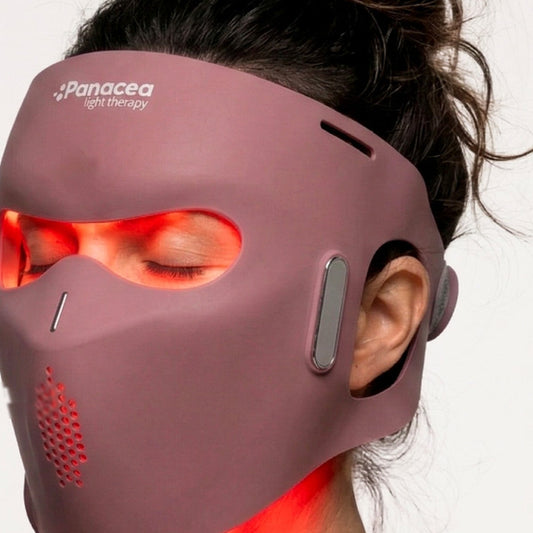
For the face, a mask is usually more practical than a panel: the light stays at an even distance, and you can simply sit while using it. The Aurora LED face mask combines red and near-infrared light; if you also want to treat the neck and chest, choose the version with décolleté coverage. The background is explained on the page about the Aurora LED mask.
| Component | Recommendation |
|---|---|
| Wavelengths | 660nm and 830 to 850nm combined |
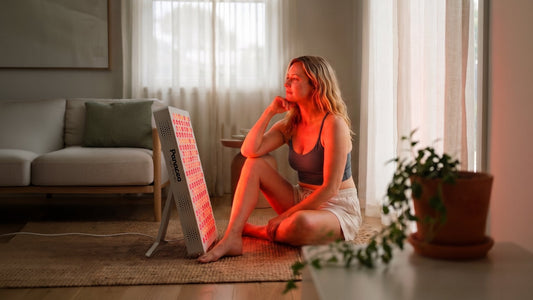
| Distance (panel) | 25 to 30 cm for the face; maintain 30 cm during the first two weeks |
| Duration | 10 to 15 minutes; 5 to 7 minutes during the first week |
| Frequency | For optimal results, use it 5 to 6 times a week; 3 times a week is the minimum. Twice a week is not enough to produce results |
| Skin | Clean and dry, without makeup, cream, or serum during the session |
| Eyes | You can close your eyes; protective glasses are included |
| Duration | Your choice, including in the evening: red light does not suppress melatonin |
One figure determines whether a session is worthwhile: irradiance, the power that reaches the skin. Research uses a minimum of approximately 100 mW/cm². Cheap devices often reach only 20 to 30 mW/cm². Panacea panels deliver a calibrated 130 to 200 mW/cm² at 15 cm. Below that threshold, you may expose your skin faithfully for months without seeing results.
The timeline: what to expect and when
Red light therapy for acne progresses in stages. During the first few weeks, you usually will not see anything yet, at most noticing that active spots feel less tense. With regular use over several weeks, users report that their skin texture becomes smoother and breakouts clear up faster. A more visible difference generally requires more weeks of consistent use. Pigmentation and small scars require even more patience, often months. Results vary from person to person.
Some people temporarily see more spots during the first few weeks. If this happens, keep the sessions short and only assess the results after several weeks of regular use. What usually goes wrong is not the technique but consistency: three sessions per week for twelve weeks do more than seven sessions in the first week followed by nothing.
If you are unsure whether this is right for your skin, you can schedule a free 15-minute video call with a specialist, without a sales pitch. Leave a question below and a real person will always read it: comments are answered by a real person within 24 hours.

When you should see your doctor or dermatologist
Red light is not a substitute for medical care. See your doctor or dermatologist if:
- Cystic or nodular acne: deep, painful lumps beneath the skin that do not come to a head.
- Acne that leaves scars. The sooner you address it, the less permanent the damage will be.
- Sudden, severe acne in adulthood, especially with an irregular cycle or excessive hair growth. This calls for hormonal evaluation.
- Acne that severely affects your mood or social life.
- Pregnancy or breastfeeding, because many common acne treatments cannot be used during these periods. You can read about what light therapy does and does not mean during this time in the article about red light therapy during pregnancy.
Light therapy can complement medical treatment, not replace it. Feel free to discuss it with your healthcare provider.
Frequently asked questions
Does red light therapy really work for acne?
Red light targets the inflammatory component and recovery after a breakout. Users report less redness, less tightness, and more even-looking skin. The research is positive but smaller and less conclusive than for skin aging. It does not address sebum production or hormonal causes, so expect support, not a solution.
Isn't blue light better for pimples?
Blue light works on bacteria through porphyrins and remains in the upper layers of the skin. Red and near-infrared light penetrates deeper and targets inflammation and recovery. We deliberately choose red and near-infrared light, partly because blue light suppresses melatonin while red light does not.
How long does it take before I see results?
Expect a buildup phase of several weeks without a clearly visible difference. With regular use over several weeks, users report finer texture and breakouts that subside more quickly; a more visible difference generally requires several more weeks of consistent use. Pigmentation and superficial scars require even more patience, often months. Fewer than three sessions per week produces virtually no results. Results vary from person to person.
Can my teenager use red light therapy?
Red and near-infrared light contains no UV and does not burn the skin. Many parents choose it for precisely that reason, as a gentler option. Start with short five- to seven-minute sessions, keep your eyes closed or use the included goggles, and consult your family doctor before use if you take medication or have severe acne.
Does red light help with acne scars and hyperpigmentation?
Fibroblasts in the dermis respond well to 660nm; studies using skin biopsies described increased collagen production with regular use over several weeks. For superficial scars and post-inflammatory spots, users report more even-looking skin after prolonged, consistent use. Deep, indented scars require dermatological techniques. Results vary from person to person.
Would you like to calmly explore whether light is suitable for your skin? View the Aurora LED face mask with red and near-infrared light, or discuss your situation in a free video consultation. If your question is not listed here, see the frequently asked questions.
Red light therapy is a wellness application and not a replacement for medical care. Results vary from person to person; consult your doctor if you have symptoms.