
Red light therapy for women: from menstrual cycle to menopause
Most research on red light therapy focuses on muscle recovery, skin, and pain. That makes sense, as those areas have the largest body of research. But there is an entire category of complaints that is rarely addressed: everything related to the female cycle, hormones, and the pelvic area. Menstrual pain. Endometriosis. Recovery after childbirth. Nipple pain during breastfeeding. Menopause.
A detailed interview on this very topic was recently published with midwife Tracy Donegan on Light Therapy Insiders. In this article, we summarize her insights, supplement them with what scientific research does and does not say about it, and translate them into what you can do with it at home.
This article follows the stages of life. Are you specifically looking for information about hormonal imbalance, PCOS, PMS, or the influence of stress on your cycle? Then read our article about red light therapy and female hormones.
Contents
- How does red light therapy work in your body?
- Red light therapy for menstrual pain
- Red light therapy for endometriosis and pelvic pain
- Red light therapy and fertility
- Pregnancy: where it is better not to use red light
- Red light therapy after childbirth
- Red light therapy during menopause
- How do you get started with red light therapy?
- Is red light therapy safe?
- Frequently asked questions

How does red light therapy work in your body?
Red light (around 660 nm) and near-infrared light (around 850 nm) penetrate the skin and are absorbed by your mitochondria, the energy factories in your cells. They contain an enzyme called cytochrome c oxidase, which captures the light. The result: your cells produce more ATP, blood flow in the exposed area improves, and inflammatory signals are adjusted.
That may sound abstract, but it explains why such diverse complaints respond to the same therapy. Red light does not target a specific condition. Instead, it gives tissue more energy to support its natural ability to heal. Tissue under strain, recovering from childbirth, or receiving less blood flow due to declining estrogen levels benefits most from this.
The technical term for this is photobiomodulation. If you want to explore this in more depth, read our article on how red light therapy works exactly or on mitochondria and ATP.
Red light therapy for menstrual pain
Of all female-specific applications, menstrual pain has been studied the most extensively. And the results are interesting.
In a randomized multicenter study published in Lasers in Medical Science, 156 women with primary dysmenorrhea (menstrual cramps without an underlying condition) were divided into two groups. One group received LED light therapy at two points low on the abdomen for three cycles. The other group received the birth control pill (ethinylestradiol/desogestrel).
The proportion of women who reported a clear reduction in pain was similar in both groups. The difference was not statistically significant. The absolute reduction in pain was greater with the pill. Interestingly, blood levels of prostaglandin E2 (the substance that causes the cramps) decreased equally in both groups.
That is a noteworthy finding. Not because light is "better" than the pill, since the pill clearly produces a greater absolute reduction in pain. But because it may be an additional option for women who prefer not to use hormones, in consultation with their doctor. To be clear: this study did not include a sham-treatment group, so some of the improvement may be a placebo effect.
More important is the study in which light therapy was compared with a sham treatment. A 2025 meta-analysis found three such studies, involving 150 women in total, and reported less pain in favor of light therapy. In the best-designed individual study (double-blind, using a placebo device, with 88 women), the pain score decreased more clearly than in the placebo group. These are still small studies, all from East Asia, so replication in Europe is still needed. But of all the applications discussed in this article, this one has the strongest evidence.
In practice, you use a flexible light therapy belt worn low around your abdomen or lower back, or sit in front of a panel. Twenty minutes, preferably not only once the pain has already started: begin a few days before your period.

Red light therapy for endometriosis and pelvic pain
Endometriosis is more complicated. There is no good research showing that red light has any effect on endometriosis tissue, and we should not suggest otherwise.
What does seem plausible is support for the pain component. Near-infrared light reaches deeper tissue, supports local blood flow, and may reduce the inflammatory response. For women who live with pelvic pain every day, an at-home addition for greater comfort is worth trying. Results vary from person to person.
Important: red light therapy does not replace medical care for endometriosis. Think of it as something you use alongside medical care, in consultation with your doctor. Read more about its effects on pain in our article about red light therapy for pain and inflammation.

Red light therapy and fertility
In the interview, Donegan raises a point that is still too often overlooked in the consultation room: when a desire to have children is not fulfilled naturally, the cause lies, at least in part, with the man in a significant proportion of cases. Yet the treatment journey often focuses solely on the woman.
For men, research suggests that photobiomodulation may support sperm motility. After all, mitochondria provide the energy a sperm cell uses to swim. Practically relevant here: sperm production takes approximately 70 to 76 days. What you do today will not show up in a semen analysis for more than two months.
That also explains why Donegan asks her clients who are trying to conceive to follow a protocol for at least three months before drawing conclusions. This is practical experience, not a study result, but it fits well with the biology.
For women, the evidence is less robust. Red light on the lower abdomen is used to support blood flow in the pelvic area, but there is no solid outcome data on pregnancy rates. Be honest with yourself about this: it is a reasonable addition, not a fertility treatment. We wrote a separate article about the hormonal aspects of this: red light therapy and female hormones.
Pregnancy: where it is better not to use red light
Clearly and without beating around the bush: do not use a powerful red light panel directly on your pregnant belly, unless it is done under the guidance of a healthcare professional trained in this area.
There is no indication that it is harmful, but there is also no research showing that it is safe. During pregnancy, that difference is important enough to warrant caution.
Light on your shoulders, neck, face, or lower back is a different matter, because it remains far from the uterus. Unsure? Discuss it with your midwife. We have written a complete article about this: red light therapy during pregnancy.
Red light therapy after childbirth
This is the area with the most research, and where the results are mixed but promising.
Nipple pain and nipple cracks during breastfeeding
This is more nuanced than you often read online. There are positive meta-analyses, but they usually compare light therapy with standard care such as lanolin or breast milk. Compared with a sham treatment—the more rigorous test—the effect has not been confirmed so far: a 2024 review found exactly two such studies, involving a total of 139 women, and found no significant difference. It is also established that a single session does not work.
Still, that is not the whole story. The latest double-blind, sham-controlled study, published in 2026, used a repeated protocol with both red and infrared light and reported less pain for up to several days after the sessions. The evidence is moving in the right direction. It is not certain yet, and that is not how we present it either.
One caveat you read everywhere—and one that is correct—is that light cannot fix an incorrect latching technique. If the cause lies in the latch, the problem will keep coming back. See a lactation consultant first, and use the light alongside that support.
Perineal and C-section recovery
For perineal injuries, stitches, and recovery after a C-section, the evidence is more mixed. Some RCTs report less pain, while systematic reviews conclude that the difference from placebo is small or not statistically significant. The dosages and wavelengths used vary considerably between studies, which partly explains the difference. In short: it may be useful, but the evidence is not yet convincing.
Practically speaking: wait until the bleeding is under control and the skin has closed, and consult your midwife or doctor before you begin.
Red light therapy during menopause
When estrogen levels drop, all kinds of things change at once. Your skin becomes thinner and drier, collagen production decreases, tissue in the pelvic area becomes more vulnerable, your sleep becomes more restless, and you recover more slowly from exertion.
The common theme is striking: it concerns tissue receiving less effective blood flow and cells working less efficiently. And that is exactly what photobiomodulation targets.
Skin and collagen
For the skin, the evidence is strongest of everything related to menopause. In a double-blind study in which one half of the face received light and the other a sham treatment, wrinkles and skin roughness decreased. More importantly, skin biopsies showed more collagen and elastic fibers. This is one of the few instances in which the effect was observed directly in human tissue, rather than only in a questionnaire.
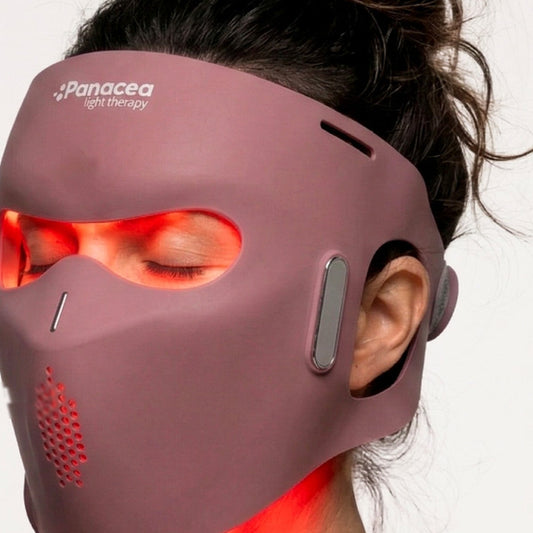
An honest caveat is needed here. A significant portion of the research on LED light therapy is funded by device manufacturers, and the most recently independently funded study did not meet its primary endpoint. The effect is real but modest. Expect smoother skin texture, not a dramatic change. Read more in our article on red light therapy for the skin. An LED face mask is the simplest option for this.

Genital and pelvic symptoms
There is significant interest in dryness, thinning tissue, and pain during sex, but the evidence is still young. Randomized research into photobiomodulation for genitourinary syndrome of menopause is now underway, but the results are not yet available. If you read that this has already been established, that is not correct at this point.
Sleep and energy
Here, something else applies, and it is not about irradiating tissue but about your biorhythm. Bright, blue-rich light in the evening keeps you awake; warm, red light does not. A session in the evening therefore fits perfectly into a wind-down routine. Read more about this in our article on red light therapy for better sleep.

How do you get started with red light therapy?
The great thing about light therapy is that the protocol is simple. The difficult part is that consistency turns out to matter more than intensity, and that is where things usually go wrong.
- Start slowly. Ten to fifteen minutes per area is enough to begin with. More is not better; photobiomodulation has an optimal dosing range, and beyond that, the effect actually decreases again.
- Keep your distance. For a panel, 15 to 30 cm is typical. A belt or mask rests against the skin.
- Be consistent. Using it three to five times a week is more effective than one long session at the weekend.
- Give it time. Skin and pain symptoms often respond to regular use over several weeks. For anything related to the menstrual cycle or hormones, expect several cycles. Results vary from person to person.
- Not noticing anything at all after a few weeks? Then it makes sense to review your protocol: distance, duration, or frequency, rather than simply continuing.

Is red light therapy safe?
Red light therapy is generally well tolerated. It contains no UV, does not burn your skin, and the adverse effects reported in studies are rare and mild. Still, there are a few clear points to keep in mind:
- Do not expose moles or skin spots that look suspicious. Have them assessed first.
- Do not use a powerful panel directly on a pregnant abdomen without supervision.
- Do not aim intense panels at newborns.
- Are you taking photosensitizing medication (certain antibiotics, some treatments for acne or autoimmune diseases)? Consult your doctor or pharmacist first.
- Do not look directly at the LEDs. With large panels used at close range, protective eyewear can be helpful.
Frequently asked questions
Does red light therapy help with menstrual pain?
Possibly. Three placebo-controlled studies involving a total of 150 women reported less menstrual pain, and in a comparison with the contraceptive pill, the proportion of women showing clear improvement was similar in both groups. These were small studies, so there is not yet enough certainty. Results vary from person to person.
Can you use red light therapy during pregnancy?
Not directly on your abdomen, unless supervised by a trained healthcare professional. There is no evidence of harm, but there is also no research confirming its safety. Using it on your shoulders, neck, face, or lower back is different, because these areas are far from the uterus.
Does red light therapy help with menopause symptoms?
For skin, the evidence is reasonably strong: studies have described an effect of red light on thinning skin and collagen loss. Research into genital and pelvic symptoms such as dryness and pain during sex is still ongoing, so there are no promises to make yet.
How long does it take before you notice results?
Skin and pain complaints often respond to regular use over several weeks, with three to five sessions per week. For anything related to your cycle or hormones, expect to need multiple cycles. If you notice no improvement at all after several weeks, first take a critical look at the distance, duration, and frequency. Results vary from person to person.
Is red light therapy safe during breastfeeding?
Yes. Light therapy applied to the nipple is specifically being studied for cracked nipples and does not affect milk production. However, light does not correct an improper latch. Consult a lactation consultant first and use the light alongside that.
Which device do you need for lower-abdominal complaints?
A flexible light therapy belt worn low around your abdomen or lower back is the most practical option for this, because you can keep it on while resting. A standing panel also works, but requires you to sit still in front of the device for twenty minutes.
What you can realistically expect
Women’s health has been underrepresented in medical research for decades, and that is reflected in this topic: the evidence is reasonably strong for menstrual pain and the skin, while research on pelvic complaints during the transition to menopause is still in its infancy.
That does not make red light therapy a miracle cure. But it does make it a generally well-tolerated, non-hormonal option that you can use at home alongside whatever else you are already doing. And for some complaints where conventional options are limited, that is more than nothing.
Questions about which device is right for what you want to address? Feel free to ask them. We are happy to help you think it through.
Disclaimer: this article is intended for informational purposes only and is not medical advice. Red light therapy does not replace medical care. Do you have symptoms, are you pregnant, breastfeeding, or taking medication? Consult your general practitioner, midwife, or specialist before you begin.
Inspired by the interview with midwife Tracy Donegan, Light Therapy Insiders. Scientific support includes: Complementary Therapies in Medicine (2025) and Lasers in Medical Science (2022) on light for primary dysmenorrhea; Breastfeeding Medicine (2024) and Lasers in Medical Science (2025) on photobiomodulation for nipple injuries; Lee et al. (2007) on LED phototherapy with skin biopsies; and an umbrella review in Systematic Reviews (2025) on the overall strength of evidence for photobiomodulation.
Red light therapy is a wellness application and not a substitute for medical care. Results vary from person to person; consult your doctor if you have symptoms.