
LED mask or laser mask: why we deliberately chose LED
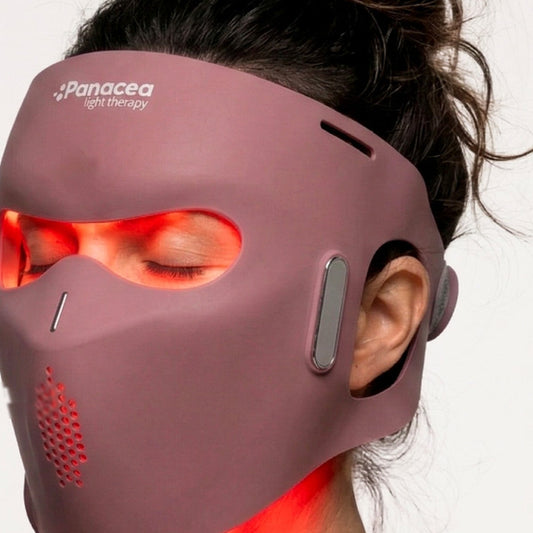
A new type of face mask is appearing increasingly often: the laser mask. With terms such as VCSEL, “3-chip laser,” and “six times more powerful than LED,” it is presented as the next step after the LED mask, at prices that rise to well over €1,000. When designing the Aurora, we deliberately chose LED rather than laser. Below, you will read why, what the actual difference is between a laser mask and an LED mask, and what to consider when making your choice.
What is a laser, and what is an LED
Both are semiconductors that produce light of a single color. The difference lies in how that light leaves the chip. An LED emits light broadly, with an angle of roughly 120 degrees, and the wavelength lies within a narrow band around the target value. A laser focuses the light into a tight beam of about 18 to 20 degrees, and the wavelength is defined even more precisely. The lasers in masks are usually VCSELs, small surface-emitting lasers that you may also recognize from facial-recognition systems in smartphones and distance sensors in cars.
For the skin, one thing is decisive: which wavelength reaches it, how much energy per square centimeter, and for how long. That process, photobiomodulation, is explained step by step on the page about how red and near-infrared light works. The light source itself is not part of that equation.
Laser mask vs. LED mask: the comparison
| Feature | Laser mask (VCSEL) | LED mask |
|---|---|---|
| Beam angle | Narrow, approximately 18 to 20 degrees | Wide, approximately 120 degrees |
| Distribution across the skin | Point-like: bright spots with less-illuminated skin between them | Overlapping: the cones of light blend into one another |
| Strength per point | High, directly beneath the laser | Even, across the entire surface |
| Coherence | Yes | No |
| Used in clinical skin research with masks | Hardly any | Virtually all research on masks |
| Eye safety | Covered by the laser safety standard, with stricter requirements | Covered by the standard for lamps and LEDs |
| Price range (September 2026) | Roughly €650 to well over €1,000; standalone laser devices for the face up to €6,000 | Roughly €150 to €600 |
Why coverage matters more than beam strength in a mask
A narrow beam is an advantage when you want to target a single point, such as a joint beneath a thick layer of tissue. A face mask does something else. It sits one or two centimeters from the skin and needs to illuminate the entire face: forehead, cheeks, jawline, and the area around the eyes.
At that short distance, a laser with a 20-degree beam creates a light spot less than a centimeter in diameter. If you place 140 of them on a mask, you get 140 bright spots, with skin in between receiving much less. An LED that emits at 120 degrees creates a spot several centimeters across at the same distance. Placed next to one another, these spots overlap and create one evenly illuminated surface. That is exactly what you want for a face.
This is also why the "power" of a laser is less valuable in a mask than it may seem. Because the mask sits against the skin, very little light is lost over distance. You therefore do not need a concentrated beam to deliver enough energy. You need good distribution.

Does coherent laser light do more in the skin
This is the argument laser-mask sellers use most often: laser light is coherent, all the waves are in phase, and that supposedly allows it to penetrate deeper and do more inside the cell. The scientific literature has settled this question for quite some time. In a widely cited review article from 2018, Heiskanen and Hamblin, one of the most frequently cited researchers in this field, examined whether lasers perform better than LEDs in photobiomodulation. Their conclusion: at the same wavelength and the same dose, there is no convincing evidence that lasers do more than LEDs. Coherence is largely lost in the upper layer of the skin due to scattering, so cells deeper in the tissue do not notice the difference.
Later studies confirm that picture. An animal study on blood vessel formation in wounds found that coherence is not necessary for the effect. A 2026 systematic review of sixteen comparative studies concluded that lasers and LEDs activate the same cellular mechanisms and have comparable effects, with some laboratory studies showing a slightly greater effect from lasers on, for example, collagen deposition. To be fair: that latter effect does exist. But these are measurements in cell cultures and laboratory animals, at exactly the same dose. With a mask on your face, where the laser delivers that dose only in spots, that theoretical advantage is outweighed by the drawback of the distribution.
"Six times more powerful": what that claim does and does not say
Manufacturers of laser masks use claims such as "three times" or "six times more powerful than LED," often with an irradiance of 140 mW/cm² or more. Two caveats.
First: irradiance is a measurement at a single point. With a laser, you measure directly beneath the beam, at the center of the spot. One millimeter farther away, the value is a fraction of that. With an LED mask, the value at each point is lower, but applies across the entire surface. An average across the skin is often higher with a good LED mask than with a laser mask; that average simply never appears on the box.
Second: more is not better. Photobiomodulation has a biphasic dose response, an inverted U. Below a threshold, little happens; above an optimum, the effect decreases again. Clinical skin studies with masks used modest irradiances, on the order of 5 to 30 mW/cm², and achieved measurable results. So a device that promises to be "six times more powerful" is offering something the research does not call for. How to interpret the stated mW/cm² is explained in more detail in the article about what is not shown on the sales page.
What was used in the skin research
When you look at the studies we and others cite on red light for the skin, it is striking how consistently they use LEDs. The frequently cited split-face study by Lee and colleagues from 2007, which found a measurable reduction in wrinkles and more collagen in skin biopsies among 76 participants, used 633 and 830 nm LEDs. Mota's randomized study from 2023, involving 137 women and showing a measurable reduction in wrinkle volume around the eyes, used red and amber LEDs at 660 and 590 nm. A French study from 2023 using a 630 nm LED mask found measurable improvement in wrinkle depth, firmness, and skin texture after three months. More about this research can be found in the article about red light therapy for the skin.
For laser masks for home use, that evidence is not yet available to the same extent. What is often cited are studies using professional laser equipment or satisfaction figures from research conducted by the manufacturer itself. That does not make the technology bad, but it does make the price difficult to justify.
Safety, eyes, and certification
A laser is legally different from an LED. LED devices fall under the standard for the photobiological safety of lamps (IEC 62471). Lasers fall under the laser safety standard (IEC 60825), with a classification system and stricter eye-protection requirements. With a face mask, which is by definition just a few centimeters from your eyes, that is not a minor detail. When considering a laser mask, always ask about the laser class and test report; not every provider can provide them.
For LED masks, the principles are: no UV, no significant heat generation, and good tolerability in clinical studies. Closing your eyes during the session is sufficient. Anyone with an eye condition or taking photosensitizing medication should consult their ophthalmologist beforehand.
Why the Aurora is an LED mask
When designing the Aurora LED face mask, we considered lasers and decided against them for the reasons above. The mask sits against the skin, so the light does not have to bridge the distance. What it does need to do is reach the entire face evenly, and 90 four-color LEDs with overlapping coverage do that better than spots. The wavelengths were chosen based on the available research: 633 nm red and 850 nm near-infrared for collagen and recovery, 590 nm amber for redness and complexion, 415 nm blue for troubled skin, and 1072 nm around the eyes. Six programs pair these wavelengths with a goal, so you do not have to choose for yourself.

A laser mask will look and sound premium for years to come. We believe your money is better spent on a device that does what the research shows it can do, and on the consistency to wear it a few times a week. The latter determines the result more than whichever chip it contains. If you are unsure what suits your skin, you can schedule a free fifteen-minute video call with a specialist, without a sales pitch.
Frequently asked questions
Is a laser mask better than an LED mask
Not according to the available research. At the same wavelength and dose, there is no convincing evidence that laser light does more than LED light, because coherence is largely lost in the skin. In a mask, the even distribution of LEDs also matters more than a laser's focused beam. Virtually all clinical skin research with masks has been conducted using LEDs.
What does VCSEL mean in a face mask
VCSEL stands for Vertical-Cavity Surface-Emitting Laser, a small semiconductor laser that emits a narrow beam of approximately 20 degrees. In a mask, this produces bright spots with less illuminated skin in between. However, not every product that says "laser" on the box contains actual VCSELs; ask for the specifications and laser class.
Does laser light penetrate the skin more deeply than LED light
Penetration depth is determined by the wavelength, not the light source. Red light from 633 to 660 nm and near-infrared light from 830 to 850 nm penetrate equally deeply from an LED as from a laser with the same wavelength. A laser delivers more energy at a single point, but that point is small in a mask.
Why is a laser mask so much more expensive
Laser chips are more expensive to manufacture than LEDs, and manufacturers position them as premium technology. Prices range from approximately 650 euros to well over a thousand euros. The price difference does not reflect a difference in demonstrated effects on the skin.
Do I need eye protection with a laser mask
Lasers are subject to a stricter safety standard than LEDs, with a classification that determines whether eye protection is required. When using a laser mask, always ask about the laser class and test report. With an LED mask, closing your eyes is sufficient; if you have an eye condition, consult an ophthalmologist beforehand.
Would you like to see what an evenly illuminated face looks like? View the Aurora LED face mask, or discuss your situation in the free video consultation. If your question is not answered here, see the frequently asked questions.
Red light therapy is a wellness application and not a replacement for medical care. Results vary from person to person; consult your doctor if you have any concerns.