
Buying a red light panel directly from China: what to look out for
Share
Anyone looking for a red light therapy panel will sooner or later end up on a marketplace where an identical-looking device costs half as much. Buying a red light therapy panel from China then seems like a matter of doing the math. We build our own panels and know that supply chain from the inside, so we can tell you what you do not see on such a product page. Not to talk you out of it: for some people, it is a defensible choice, and we say that honestly. But only after doing the full calculation.
The short answer
Buying a red light therapy panel from China is usually less inexpensive than it seems and always riskier than it seems. Import duties, VAT, and handling fees are added to the asking price. You are also buying outside European consumer protection law, without a practically enforceable warranty, without service in Dutch, and without verifiable measurements of what the device actually delivers.
Buying a red light therapy panel from China: what you really pay
The price shown on the screen is rarely the price you pay. When importing from a country outside the EU, three additional charges apply, and they only become visible once the package is already on its way.
| Item | What it is | What to take into account |
|---|---|---|
| Import VAT | Dutch VAT on the value of the goods plus shipping costs | Generally 21 percent |
| Customs duties | Import duty based on the product's commodity code | The percentage varies by product type; since July 1, 2026, the former exemption for shipments up to €150 has been abolished |
| Handling fees | A fixed fee charged by the carrier for the customs declaration | Each carrier uses its own rate |
| Shipping costs | Sometimes included, sometimes charged afterward | Rarely negligible for a panel weighing fifteen to thirty kilograms |
Apply that calculation to a panel listed at €600 on the product page. Including VAT, import duty, and handling, you can quickly be looking at around €800—and you still have a device whose specifications you cannot verify. Much of the price difference you saw on the screen has therefore evaporated.
There is another cost that only becomes apparent later. If something breaks or the device disappoints you, returning a panel of this size to Asia is often more expensive than the panel itself. In practice, that means you keep it or put it away.
Which unit are you actually getting?
This is the part that almost nobody outside the industry knows. Manufacturers produce in large batches for business customers, and some units are rejected during quality control in every batch. Think of panels with several diodes outside the tolerance range, housings that are not flat enough, or control systems that are just not stable enough.
Those units are not discarded. They are often sold individually to private customers who order through a marketplace. We are not saying this happens everywhere, nor that every panel purchased directly is rejected. We are saying that you have no way to see the difference, because from the outside a rejected panel is identical to an approved panel. The difference lies in the measurement, and you do not receive that.
Why the stated measurements are often incorrect
With red light therapy, everything revolves around one number: irradiance, or how much light energy actually reaches your skin, expressed in mW/cm². For the dose used in research, the general assumption is a minimum of approximately 100 mW/cm² on the exposed skin. Entry-level devices often deliver just 20 to 30 mW/cm².
The problem is that this number is easy to exaggerate and difficult to disprove. A value measured at zero centimetres, or with a meter that includes the full spectrum instead of only the effective wavelengths, looks impressive on paper and says nothing about your session. We previously wrote in detail about what those numbers really mean.
You should be able to request the measurement distance, the measuring instrument used and a spectral report for the diodes. If you do not receive these, you are buying a number, not a device.
Who actually designed this device
This is the question almost nobody asks, yet it explains the most. A large proportion of the devices on the market come from the same handful of factories, which offer their models in a catalogue. Anyone who buys a batch can have their own logo added, choose their own colour and have their own packaging printed. In the industry, this is called OEM or private label. That is how a brand is created without anything being designed.
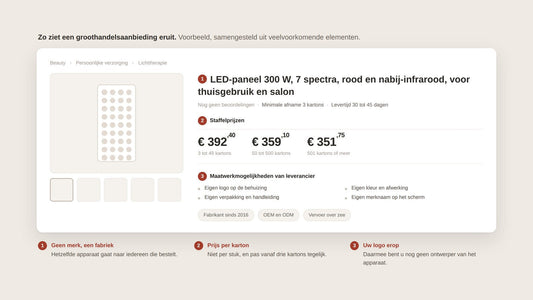
The image at the top of this article shows what such an offer looks like in practice. We assembled this example from elements that repeatedly appear on pages of this kind, so it does not concern an existing supplier. Pay attention to the prices: they apply per carton and only from a minimum order quantity. And look at the list of customisation options. Your logo on the housing, your brand name on the display, your own packaging. Everything can be different except the device itself.
Private labeling is not inherently wrong. Half of all supermarkets operate on it, and there are plenty of companies that openly say they source and resell products. But it does explain why devices from different brands look so similar: they are often the same devices. And it explains why some brands cannot answer a technical question, because they did not design the device and therefore cannot change anything about it.
Four questions that reveal the difference, for us just as much as for anyone else:
- Who determined the diode placement pattern, and why was this arrangement chosen?
- Are the CE, RoHS, and FCC reports in the brand's name or in the factory's name?
- Can the brand show a spectral report for the diodes in this series?
- Is the control system proprietary, or is it a standard module used in multiple devices?
If you get a concrete answer to all four questions, you are dealing with a designer. If you get vague answers or referrals to a supplier, you are buying from an intermediary. That is fine, as long as you know it, because it determines whom you can turn to if something goes wrong.
Warranty, service, and what happens after fourteen months
If you buy from a seller outside the EU, you are also buying outside European consumer law. The fourteen-day right of withdrawal you have with a Dutch or European online store does not apply there. And the legal protection you have in the Netherlands when a product does not do what you may reasonably expect is, in practice, almost impossible to enforce against a party on the other side of the world.
On paper, you often do get a warranty. The question is what it is worth if the panel fails after fourteen months. Who decides whether it is a warranty case, who pays for shipping, and who do you contact if the sales account no longer exists? The same applies to a simple question about the protocol. There is no number to call and no person monitoring messages.
Then there is the delivery time. Six to ten weeks is not unusual, and if there is a delay at customs, no one can tell you where your package is.
Certificates, EMF, and safety
Almost every panel displays the CE, RoHS, and FCC logos. Those logos mean little on their own, because they are easy to print. What matters is whether the manufacturer can provide the corresponding test reports in its own name, and whether those reports concern this device rather than another model from the same factory.
A second point that is rarely discussed is EMF, the electromagnetic field produced by a panel's power supply and control system. For a device you sit close to for ten to fifteen minutes, that is relevant. In devices that come directly from a factory and whose power supply was not designed with this in mind, that field may be higher. We deliberately say “may”: without measurement, nothing meaningful can be said about a specific device, and that is precisely the problem.
Finally, the plug and mains voltage. A device designed for a different power grid, used with an adapter plug in a Dutch socket, is not a minor detail for a device of this size.
How we do it ourselves
We are not a neutral party in this story, so please read this with that in mind. What we do differently from a panel that comes directly from a factory is outlined below, and you are welcome to question us about it. You can read more about the background on the page about our production process and the page about the ATP Pro series.
- Our own diode layout. We designed the distribution of the diodes across the panel and the combination of wavelengths ourselves rather than taking them from a standard catalog. That layout determines how evenly the dose is distributed across your body, and in a panel, this is at least as important as the total power.
- Larger LED chips. We use larger chips than are common in entry-level equipment, providing more power per diode at a lower load per chip. This benefits their service life.
- Our own touchscreen design. The control system is ours—not a standard module with a different label attached.
- Calibrated measurements. Our panels measure 130 to 200 mW/cm² at fifteen centimeters, measured with calibration, and the diodes are supplied with spectral reports within five nanometers of the target value.
- Our own certification. CE, RoHS, and FCC certifications are in our name, with the corresponding reports for our devices.
- Long service life. The diodes are rated for more than 50,000 operating hours, with less than ten percent loss over ten years, and are flicker-free.
- Shipped from the Netherlands. With DHL and a signature on delivery—no customs, no import duties, and no weeks of waiting.
- A human being on the other side. Warranty and service are handled by us, in Dutch.
If you are unsure between models or want to discuss something before choosing, you can schedule a free fifteen-minute video call with a specialist. No sales pitch, and useful even if you ultimately buy nothing from us. If you would rather leave a question below, a person always reads it: comments are answered by a person within 24 hours.
When buying directly does make sense
There is a group for whom the calculation works out differently, and it would be unfair to conceal that. If you are technically proficient, have a meter to check irradiance yourself, can assess a power supply, and consciously accept being without a warranty or service, buying directly can be a defensible choice. Especially if you want to experiment and the device is not your only one.
If you want a device that will last for years of daily use, want someone you can turn to if something goes wrong, and want to be sure you are getting the dose stated on paper, you do not get that peace of mind with a direct order. This is not a criticism of anyone who chooses to do so. It is a trade-off, and you should make it with all the information at hand.
Checklist before ordering
If you are still considering buying directly, make sure you go through these points before paying.
- Ask at what distance and with which instrument the stated mW/cm² was measured.
- Ask for a spectral report on the diodes used, not a product photo.
- Ask for the CE, RoHS, and FCC reports issued in the manufacturer's name, specifying this model number.
- Ask who pays the import duties and VAT, and whether they are already included in the price.
- Ask what happens if the device develops a defect after twelve months, and who pays for the return shipment.
- Ask whether the device is configured for 230 volts and which plug is included.
- Calculate the total cost before comparing, not the asking price.
If you want to know what else to consider when choosing a panel, our article on choosing a suitable panel and the explanation of single and dual LED chips can help. How it works is explained on the pillar page about how red and near-infrared light works, with the supporting evidence in our overview of scientific research.
Frequently asked questions
Is a red light panel from China much cheaper?
On the sales page, yes, but much less overall. The asking price is increased by VAT, customs duties, and the carrier's handling fees, along with shipping costs that are sometimes charged only afterward. Factor in these costs before comparing. The difference from a panel bought in the Netherlands then becomes much smaller than it initially appeared.
How much import duty and VAT do I pay on a panel from China?
Expect to pay 21 percent VAT on the value of the goods plus shipping costs, along with import duty depending on the product's commodity code. Since July 1, 2026, the former exemption for shipments up to 150 euros has been abolished. The carrier also charges a fixed fee for the customs declaration. Current rates are listed on the Customs website.
Why are the stated mW/cm² values often inaccurate?
Because the output is rarely calibrated or measured at a realistic distance. A measurement at zero centimeters, or with an instrument that covers the entire spectrum instead of only the active wavelengths, produces a much higher figure than what reaches your skin during a session. Always ask about the measurement distance, instrument, and a spectral report.
Do I have a warranty if I buy directly from a Chinese manufacturer?
On paper, often yes; in practice, it is rarely useful. You are buying outside European consumer protection law, so the fourteen-day right of withdrawal does not apply, and your statutory protection is barely enforceable against a party outside the EU. Returning a panel of this size also often costs more than the device is worth.
Is EMF a reason not to buy directly?
It is something worth asking about, not a reason to panic. The power supply and control circuitry of a panel produce an electromagnetic field, and in devices whose power supply was not designed with this in mind, that field may be stronger. Without a measurement, nothing can be said about a specific device, and with a direct order, you usually do not receive that measurement.
Would you like to see what we offer instead? Take a look at the ATP Pro 700 for half-body use or the ATP Pro 1500 for full-body use. If your question is not answered here, see the frequently asked questions.
Red light therapy is a wellness application and not a substitute for medical care. Results vary from person to person; consult your doctor if you have any complaints.