
Why we don't use blue LEDs in our red light panels and you should be happy about that
Share
In the world of light therapy, it can sometimes seem as though “more colors” automatically means better. That is why some brands add a few blue LEDs to their red light therapy panels. It sounds advanced, but is it really?
We say no. In fact, we deliberately choose not to do so. In this article, we explain exactly why.
What does blue light actually do?
Blue light (around 415–470 nm) has two well-researched applications:
-
Suppressing melatonin
Blue light inhibits melatonin production. That is exactly why it feels invigorating in the morning or during the day and helps you feel more awake. But it is also why it can cause sleep problems in the evening if you spend too much time in front of a screen. -
Supporting acne treatment
Blue light can inhibit bacteria, particularly Propionibacterium acnes, which are involved in inflammation and blemishes. This effect is only achieved at high intensity, with sufficient exposure and repetition, typically using special LED masks or compact panels placed close to the face.
Why a few blue LEDs in a large panel are a waste
A red light therapy panel is designed around infrared and red light, at wavelengths of 630–660 nm and 810–1060 nm. These stimulate ATP production in the mitochondria, support cellular repair, and may help reduce inflammatory responses in muscles, skin, and joints. Every LED matters.
When you add a few blue LEDs to such a panel, this happens:
-
You give up valuable space
Every blue LED means that there is no effective red or infrared light in that spot. And that is a waste. Especially with single-chip LEDs, where each LED emits only one wavelength, you literally lose power in the places where you need it. -
The dose of blue light is too low to have an effect
A handful of blue LEDs on a large body panel is nowhere near enough to wake you up or make a difference for blemished skin. Waking up requires intense, concentrated blue light directed at your retina, such as that provided by special wake-up lamps or lightboxes with hundreds of lux. For acne, you need a targeted dose of >60 J/cm², which you can only achieve with a face mask or targeted use at close range.
Why it is better to address acne (or an energy boost) separately
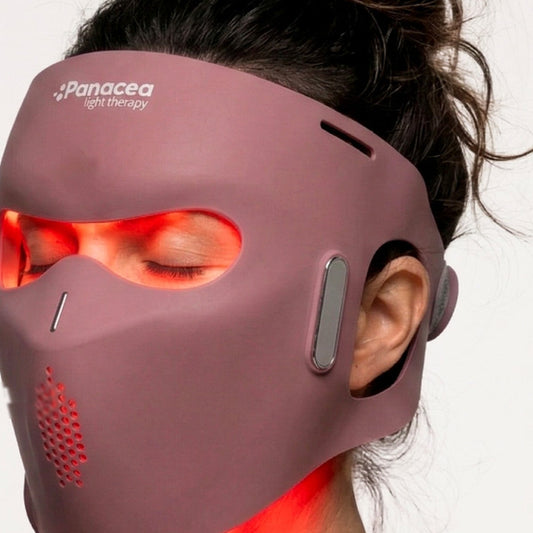
If you want to address acne, choose a device specifically designed for that purpose. For example, a face mask with blue and red light, placed close to the skin, with the correct dose and frequency.
Do you want to increase your energy levels or influence your biological clock with light? Then use a special daylight lamp in the morning, with high lux levels that genuinely help you feel more awake; for example, 10,000 lux at a distance of 30 cm.
A few blue LEDs hidden in a full-body panel simply do neither effectively.
Our philosophy: every LED matters
At Panacea Light Therapy, we believe in thoughtful design. Every LED chip in our panels is selected based on:
- Scientific evidence
- Synergy between wavelengths (such as 630 nm + 660 nm for skin, and 850 nm + 1060 nm for deep recovery)
- Effective dose per square centimeter
That is why we use only red and infrared light. No gimmicks, no marketing colors. Only what has been described in research.
Supporting research
-
Hamblin (2017) – Mechanisms of red and near-infrared light therapy on cellular function
Michael R. Hamblin describes how red and near-infrared light stimulates mitochondrial ATP production via cytochrome c oxidase, with benefits for tissue repair.
📄 Link: PubMed PMID 29164625 -
Lademann et al. (2009) – Penetration depth of visible light into human skin
Lademann and colleagues describe how blue light (penetration of <1 mm) barely penetrates the skin, while red/infrared light penetrates several millimeters
📄 Link: PDF article via Sciendo -
Wang et al. (2017) – Blue light-induced oxidative stress in skin
Yuya Nakashima et al. (2017) show that blue light selectively causes oxidative stress in skin cells and mitochondria, which has been linked to skin aging
📄 Link: PubMed PMID 28315451 | DOI 10.1016/j.freeradbiomed.2017.03.010 -
Papageorgiou et al. (2000) – Blue-red light vs. benzoyl peroxide in acne therapy
This study compares blue (415 nm) and combined blue-red light therapy for acne. The researchers reported fewer inflammatory lesions with regular use over several weeks
📄 Link: PubMed PMID 10809858
In summary: preferably no blue light in panels
Blue light has its place. But that place is not in a red light therapy panel.
✔️ Too little intensity for acne
✔️ Too little light dose for energy
✔️ May even increase oxidative stress
✔️ Comes at the expense of red/infrared power
✔️ Works primarily at close range, not for full-body applications
That is why we choose a thoughtful design, with all LEDs focused on what matters: recovery, skincare, comfort for pain complaints, and energy from within. Results vary from person to person.
Red light therapy is a wellness application and not a substitute for medical care. Results vary from person to person; consult your doctor if you have any complaints.