
What is red light therapy?
Share
Everything you need to know about photobiomodulation, wavelengths, and applications
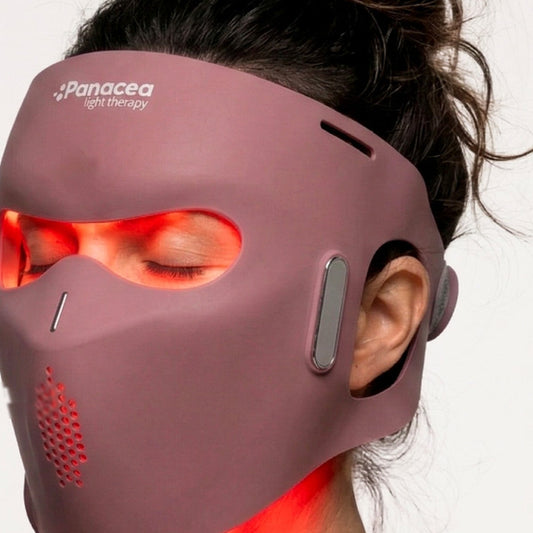
Red light therapy, also known as photobiomodulation therapy, is an innovative and rapidly growing wellness application that uses light at specific wavelengths to support the body at the cellular level. Red light therapy is completely non-invasive and generally well tolerated. The technology behind it is being extensively researched and is now widely used in sports, skincare, and wellness.
At Panacea Light Therapy, we use the wavelengths most commonly used in research: 630 nm, 660 nm, 810 nm, 850 nm, 940 nm and 1060 nm. Each wavelength has unique effects and penetrates to a different depth in the tissue.
How does red light therapy work?
The effects of red light therapy are attributed to a process called photobiomodulation. This means that light photons are absorbed by mitochondria, the energy factories of our cells. Specifically, the enzyme cytochrome c oxidase responds to this light, resulting in the production of more ATP (adenosine triphosphate): the cell's fuel.
What happens in the body?
- Support for cell renewal
- Increased blood flow
- Reducing inflammatory responses
- Supporting muscle recovery
- Stimulation of collagen production
- Improved oxygen uptake in cells
The effect depends on the wavelength used. The longer the wavelength, the deeper the light penetrates into the body.
The wavelengths of Panacea Light Therapy
630 nm: for superficial skin layers
The 630 nm wavelength is primarily studied for skin rejuvenation, skin healing, and reducing inflammatory responses in the upper layers of the skin. It supports cell renewal and stimulates collagen synthesis.
Applications: scars, rosacea, superficial acne
Supporting research: Salehpour et al. (2019), link
660 nm: skin rejuvenation and reducing inflammatory responses
This is the most extensively researched red wavelength, with numerous studies published on skin health and reducing inflammatory responses.
Applications: skin aging, eczema, skin healing
Research: Lim (2021), SPIE
810 nm: deep action for muscle and nerve tissue
The 810 nm wavelength can penetrate deeply into muscle tissue and nerves. It is often studied for muscle pain, sports injuries, and support for brain function.
Applications: muscle recovery, osteoarthritis, brain function
Research: Lin et al. (2024), Neurophotonics
850 nm: reducing deeper inflammatory responses
The 850 nm infrared waves are being studied for supporting lymphatic flow, muscle recovery, and reducing prolonged inflammatory responses.
Applications: support for rheumatic complaints, fibromyalgia, lymphatic recovery
Research: Hernández-Bule et al. (2024), MDPI
940 nm: support for pain and circulation
With its deep-penetrating capability, 940 nm is suitable for joints, tendons, and deep muscles. This wavelength has also been linked in research to support for microcirculation and oxygen supply.
Applications: joint pain, muscle tension, back problems
Research: Salehpour et al. (2019), Liebertpub
1060 nm: innovative for deep tissue and brain support
This relatively new wavelength has a unique property: it penetrates deeply into deeper tissue and brain tissue. It is often used in research for cognitive support and support for energy metabolism.
Applications: research into brain function, support for energy metabolism in deeper tissue
Research: Lin et al. (2024), Neurophotonics
What are the benefits of red light therapy?
1. Skin improvement
Red light may contribute to the texture, elasticity, and overall appearance of the skin. It is used for:
- Reducing fine lines
- Support for acne
- Supporting skin recovery from scars
2. Support for pain relief
By tempering inflammatory responses, red light may naturally help reduce muscle and joint pain.
3. Supporting muscle recovery
Athletes use light therapy to support muscle recovery after exercise and their performance.
4. Supporting brain functions
Research describes that certain wavelengths (810 to 1060 nm) may support cerebral blood flow and cognitive functions.
5. Supporting energy metabolism
1060 nm is being studied to support energy metabolism in deeper tissue in a non-invasive way, without burdening the surrounding tissue.
Supporting studies:
- Salehpour, F. et al. (2019). Photomedicine and Laser Surgery. https://www.liebertpub.com/doi/abs/10.1089/photob.2019.4676
- Lin, H. et al. (2024). Transcranial photobiomodulation for brain diseases. Neurophotonics. https://www.spiedigitallibrary.org/journals/neurophotonics/volume-11/issue-1/010601
- Hernández-Bule, M. L. et al. (2024). Photobiomodulation on skin regeneration. MDPI. https://www.mdpi.com/1422-0067/25/8/4483
- Lim, S. (2021). Photobiomodulation for neurodegenerative diseases. SPIE Proceedings. https://www.spiedigitallibrary.org/conference-proceedings-of-spie/11628/116280O
Would you like to benefit from the advantages of red light therapy described in research? Discover our devices or contact us without obligation for personal advice.
Red light therapy is a wellness application and not a substitute for medical care. Results vary from person to person; consult your doctor if you have any complaints.