
Red light therapy for long COVID
Anyone who does not recover for months after a COVID infection eventually comes across red light therapy for long COVID. Often after trying many other things. You deserve an honest answer, even if it is uncomfortable: research into photobiomodulation for long COVID is still in its infancy. There is no evidence that red or near-infrared light eliminates or resolves long COVID. Anyone who promises you otherwise should be treated with suspicion. What can be said is explained below.
What do we really know about red light therapy for long COVID?
Research into red light therapy for long COVID consists mainly of small studies, pilot studies, and case reports, usually without a good control group. There is no evidence that photobiomodulation eliminates long COVID. The mechanism is biologically plausible and participants sometimes report less fatigue, but that is not the same as evidence-based effectiveness.
We sell panels, so you are right to be critical of what we write. That is precisely why we want to state this clearly: anyone who tells you that a lamp will eliminate your symptoms is selling you hope instead of information. That is the most harmful thing a provider can do here.
The line of reasoning: fatigue and mitochondria
Still, it is no coincidence that people searching for terms such as photobiomodulation long COVID and long COVID LED end up here. There is a line of reasoning worth taking seriously.
Persistent fatigue after an infection has been linked in research to impaired mitochondrial function. Mitochondria are the cell's power plants: they produce ATP, the fuel that virtually every process runs on. In some people with post-COVID fatigue, there are indications that this system works less efficiently, resulting in reduced exercise tolerance.
Photobiomodulation acts on that system. The electron transport chain contains cytochrome c oxidase, an enzyme that is sensitive to red light around 660 nanometers and near-infrared light from 830 to 850 nanometers. When exposed to light, nitric oxide is released, ATP production speeds up, and brief bursts of reactive oxygen are generated that act as repair signals. Read more on our cornerstone page about how red and near-infrared light work.
The reasoning is therefore: if the symptoms are related to impaired energy metabolism, and LED therapy acts on that system, then light could help. And that is precisely where the problem begins.
Plausible is not the same as evidence-based
Medical history is full of plausible mechanisms that produced nothing in practice. A mechanism tells you that something could work. A well-designed study tells you whether it makes a difference, and how much. That second part is largely missing here:
- Small pilot studies, often without a placebo group or blinding.
- Protocols vary widely in wavelength, dose, and session duration, making the results barely comparable.
- Outcome measures are based on questionnaires, which are sensitive to expectations and the fluctuating course of long COVID.
- There is no long-term follow-up, so there is no insight into what remains after six months.
In addition, long COVID is not a single disease presentation. The same label includes people with shortness of breath, people with cognitive symptoms, and people who become exhausted after the slightest exertion. Different mechanisms are probably involved. What helps one group may have the opposite effect on another.
You can find the broader research base behind photobiomodulation, which is more robust for skin, pain, and tissue repair, on our page about scientific research into red light therapy. Strong evidence for one application says nothing about another.

Post-exertional malaise: the most important warning
If you take away one thing from this article, let it be this. Many people with long COVID experience post-exertional malaise: a worsening of symptoms that occurs only hours to days after exertion and can last for weeks. That delay makes it deceptive: you feel nothing during the session, then two days later you are completely incapacitated.
A light session is not insignificant for the body. You remain standing or seated, you become warm, and an additional stimulus is introduced. With limited exercise tolerance, that may already be enough to push you beyond your limit. The usual advice of ten to fifteen minutes does not apply here.
Therefore, consult your treating physician or a post-COVID physical therapist before you begin. They know your tolerance and can help assess whether this fits within the gradual build-up plan you are already following. Red light therapy does not replace medical care or supervised rehabilitation.
Starting red light therapy cautiously with long COVID
If you and your healthcare provider decide to try it, start at a lower level and build up more slowly than with any other application. The schedule below is a framework, not a prescription.
| Phase | Distance | Duration | Frequency |
|---|---|---|---|
| Weeks 1 to 2 | 30 cm | 3 to 5 minutes | 2 to 3 times per week |
| Weeks 3 to 4 | 30 cm | 5 to 7 minutes | 3 times per week, only if symptoms are stable |
| Weeks 5 to 8 | 25 to 30 cm | 7 to 10 minutes | 3 to 4 times per week |
| After that | 25 to 30 cm | 10 minutes | In consultation, only if you have improved |
A few related guidelines:
- Never increase two things at once: either the duration, the frequency, or the distance.
- After each increase, wait at least two weeks so that any delayed reaction can become apparent.
- Keep a log: date, duration, distance, and how you felt during the following two days.
- If your symptoms worsen, stop. Do not reduce it—stop. Then consult your healthcare provider before starting again at a lower level.
- If you genuinely notice nothing after eight to twelve weeks, it probably does not add anything for you.
The sleep path and the recovery path
More realistic than hoping for a quick solution is to look at two specific symptoms that often play a role in long COVID and for which the research basis is somewhat stronger.
The first is sleep. Many people with post-COVID fatigue sleep poorly, and bad nights make all other symptoms worse. Unlike blue light, red light does not suppress melatonin production, so a short evening session should in principle be possible without disrupting sleep onset. You can read about how this relates to your internal clock in the article on red light therapy and sleep. Here too, the studies are small and the effects modest.
The second is local recovery. Muscle complaints and stiffness are common after a prolonged illness. The research basis is strongest for pain and tissue recovery: macrophages shift into a restorative mode and microcirculation improves. This is described in the articles on red light therapy for pain and inflammation and red light therapy for muscle recovery. Those articles assume a normal capacity for exertion. For you, the lower doses in the table above apply.
Both paths are more modest than what you were looking for. They are also more honest: better sleep and less stiffness are not small things when your days have been narrow for months.
What to look out for in promises
The long COVID market attracts providers with little to lose. Warning signs to step away:
- Firm promises are made about complete recovery within a few weeks or “switching off” inflammation.
- Success stories are shown without any reference to research.
- It is recommended to taper off medication or rehabilitation for light therapy.
- The device does not state any measured irradiance, only the wattages of the LEDs.
That latter point is technically relevant. Research generally uses a minimum of approximately 100 mW/cm² at the exposed area. Cheap devices reach 20 to 30 mW/cm². Panacea panels have a calibrated output of 130 to 200 mW/cm² at 15 cm. That says something about the device, but nothing about whether light works for long COVID.

Which device is right for this purpose
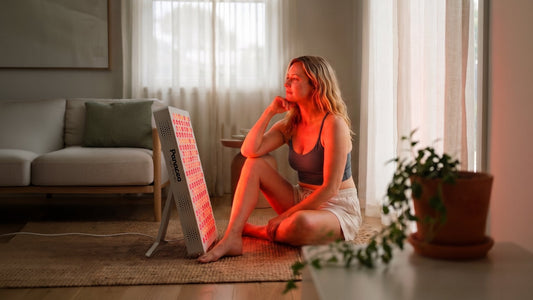
If you try it, you want to receive enough light from a comfortable distance without making the session too long. A large panel such as the ATP Pro 1500 makes this possible: you stay at 30 cm, reach a large part of the body at once, and keep the session short. Sitting rather than standing is preferable here. Protective glasses are included, and you can also keep your eyes closed.
Unsure? Feel free to schedule a free fifteen-minute video call with a specialist. No sales pitch: with long COVID, “wait a little longer and consult your doctor first” is an outcome we regularly recommend. A person always reads the comments below this article as well: ask a question in the comments and a colleague will respond within 24 hours.
Frequently asked questions
Does red light therapy help with long COVID?
There is insufficient evidence for that. The research consists of small studies and pilot studies, often without a control group. There is no evidence that red light therapy eliminates or cures long COVID. The mechanism is plausible and some users report less fatigue, but that is not evidence of effectiveness.
Why, then, is photobiomodulation mentioned in connection with long COVID?
Because persistent fatigue has been linked in research to impaired mitochondrial function, and photobiomodulation acts on that same system via cytochrome c oxidase. This reasoning explains why it is being studied, but does not show that it makes a difference for people with long COVID.
I have post-exertional malaise. Can I try this safely?
Only after consulting your doctor or a post-COVID physical therapist. A session is a stimulus and may be too much for someone with limited exercise tolerance, with a relapse occurring only days later. Start extremely low, three to five minutes at 30 cm, and stop if symptoms worsen.
How long does it take before I might notice anything?
Red light does not work like a switch; its effects build gradually. With normal exercise tolerance, effects are generally assessed only after several weeks of regular use. With long COVID, progress is slower, so allow eight to twelve weeks before assessing whether it helps. If you notice nothing by then, it probably is not adding anything. Results vary from person to person.
Can I replace my rehabilitation or medication with this?
No. Red light therapy does not replace a doctor, medication, or supervised rehabilitation. Never reduce or stop anything because you are starting light therapy. Anyone who advises you to do so is acting irresponsibly. At most, consider this something that complements your treatment, and discuss it with your healthcare provider beforehand.
Would you like to discuss your options first, without pressure? View the ATP Pro 1500 or get in touch. We are happy to think it through with you, even if the conclusion is that this is not the right solution for you at this time.
Red light therapy is a wellness application and not a replacement for medical care. Results vary from person to person; consult your doctor if you have symptoms.