
Red light therapy for hair loss
Thinning hair is rarely something you notice from one day to the next. It becomes apparent in bright bathroom light, in a side-profile photo, or from what remains in the brush. People searching for red light therapy for hair loss usually want to know just one thing: does it really do anything, or is it an expensive lamp? In this guide, you will learn how the hair growth cycle works, what goes wrong with androgenetic alopecia, what 660nm can and cannot mean for the scalp, and why this is the slowest application area for red light therapy.
The hair growth cycle: anagen, catagen, and telogen phases
Each hair follicle goes through its own cycle, independently of the surrounding follicles. That is why you lose individual hairs rather than clumps, and why every change takes so long.
- Anagen phase (growth). The follicle actively produces hair for two to six years. On a healthy scalp, 85 to 90% of hairs are in this phase, growing by approximately one centimeter per month.
- Catagen phase (transition). Two to three weeks during which the follicle shrinks and the hair detaches from the nourishing papilla.
- Telogen phase (rest). Approximately three months. The hair no longer grows and falls out when a new hair begins growing underneath. Fifty to one hundred hairs per day is normal.
The cells in a follicle during the anagen phase are among the fastest-dividing cells in the body. Anything that affects energy supply or blood flow only becomes apparent months later.
What goes wrong in androgenetic alopecia
In hereditary hair loss, androgenetic alopecia, the follicle is sensitive to the hormone DHT, a conversion product of male sex hormones (androgens). In men, this sensitivity occurs at the temples and crown; in women, diffuse thinning tends to develop around the part while the hairline remains intact.
The process is called miniaturization. The anagen phase becomes shorter, and the follicle produces thinner, lighter hair until only a barely visible vellus hair remains. If this situation persists for years, the follicle becomes scarred and disappears. That is irreversible, and it is the most important boundary in this story.
Red light therapy for hair loss: what happens in the scalp
Red light therapy for hair loss does not act on hormones or stop the underlying process. 660nm red light penetrates 5 to 10mm, reaching the hair follicle in the dermis. Research suggests that the follicle's energy supply and blood flow may benefit from this. It supports what is still alive, rather than creating new growth.
The mechanism is called photobiomodulation. Cytochrome c oxidase, an enzyme in the mitochondrial electron transport chain, is sensitive to red and near-infrared light: when exposed to light, nitric oxide is released and ATP production accelerates. The pillar page on how red and near-infrared light works explains this process step by step, based on research conducted at institutions including Harvard Medical School and NASA, with more background in the article about mitochondria and ATP.
A follicle in the anagen phase needs a great deal of energy, and microcirculation determines how much oxygen and how many nutrients reach the papilla. That is why studies on LED hair growth examine hair density and hair thickness, not bald patches filling in. To be honest about the evidence: the studies are small, short, and often funded by manufacturers, and where an effect was described, it involved modest gains. Read more on our page about scientific research into red light therapy.

The key distinction: is the follicle still alive?
Light can only support what is still there. That determines whether light therapy for the scalp makes sense in your situation.
- A miniaturized follicle is still alive. If you can still see fine, short hairs in the thinning area under good lighting, the follicle is active and there is something to support.
- A follicle that has disappeared does not come back. If an area has been bald, smooth, and shiny for years without a single vellus hair, the tissue has become scarred. No light source can change that.
- Earlier is better than later. Not because there is more to gain, but because there are more follicles to support.
That is why we do not promise new hair growth. Users mainly report that the hair they still have feels stronger and that less of it remains in the brush.
First, the cause: hormones, iron, stress, and childbirth
Not all hair loss is hereditary, and that distinction is more important than the choice of device. In some cases, the hair recovers on its own.
- Hormonal causes. Disrupted hormone levels can cause diffuse hair loss, often accompanied by fatigue or a changed energy level.
- Iron deficiency. Low ferritin is common among people with heavy menstrual periods and those who eat little or no meat.
- Stress, illness, or surgery. These can push many follicles into the telogen phase at the same time. Shedding only begins two to three months later and is usually temporary.
- After giving birth. During pregnancy, many hairs remain in the anagen phase for longer. They then transition anyway, resulting in significant shedding around the third month, which generally recovers within a year.
- Round, sharply defined bald patches. This is consistent with alopecia areata, an autoimmune reaction, and should be assessed by a doctor.
Have your doctor rule out the cause first, with blood tests if necessary. Red light therapy does not replace that step. If you are pregnant, first read the article about red light therapy during pregnancy.
Red light therapy protocol for hair loss
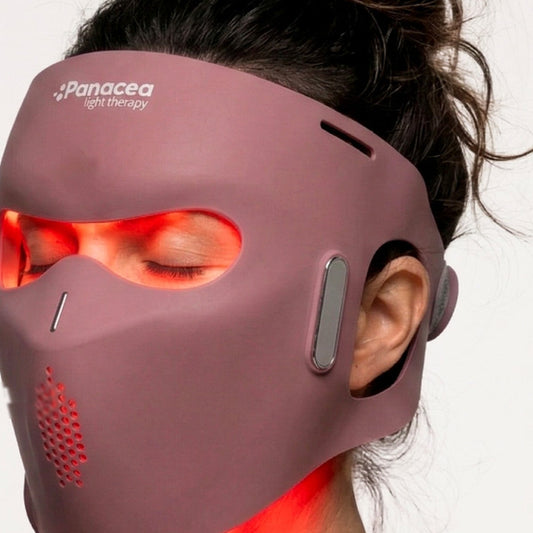
For the scalp, a panel at eye level is more convenient than a mask: you turn your head and determine which part receives the light. The Aurora LED mask is designed for the face, not the crown. The ATP Pro 350 is the compact entry-level model, while the ATP Pro 700 provides a wider coverage area.
| Component | Recommendation |
|---|---|
| Wavelength | 660 nm reaches the follicle in the dermis; near-infrared can be used alongside it |
| Distance | 25 to 30 cm; maintain 30 cm during the first two weeks |
| Hair | Create partings in sections so that the light reaches the scalp |
| Duration | 10 to 15 minutes per area; during the first week, 5 to 7 minutes |
| Frequency | Optimal: 5 to 6 times a week; 3 times is the minimum, while 2 times has no effect |
| Care | No wax, oil, or dry shampoo in the hair |
| Eyes | You can keep your eyes closed; protective glasses are included |
| Timing | Flexible timing, including in the evening: red light does not suppress melatonin |
Thick, dark hair absorbs a lot of light: parting it into sections determines whether the light reaches the scalp.
The same threshold that recurs throughout light therapy applies here: research generally uses a minimum of approximately 100 mW/cm², while inexpensive devices often reach only 20 to 30 mW/cm². Panacea panels deliver a calibrated 130 to 200 mW/cm² at 15cm. You can read about how an evening session does not disrupt sleep in the article about red light therapy and sleep.
The timeline: the slowest application area
Of all applications, the scalp requires the most patience. The reason is arithmetic: hair grows about one centimeter per month. Even if a follicle functions better today, that hair still has to grow for months.
Expect at least four to six months before anything might be visible, and nine to twelve months for a fair assessment. Some users notice after a few weeks that less hair is left in the brush, but counting hairs is an unreliable measure. Results vary from person to person.
Take photos instead: the same light, the same angle, the same parting, once a month, and compare month six with month zero. Red light does not work overnight; its effects build up. If you stop after three weeks, you will have nothing to show for it.
If you are unsure whether this is worthwhile in your situation, you can schedule a free fifteen-minute video call with a specialist, without a sales pitch. We will also tell you when we think it is unlikely to help you. If you would rather leave a question below, a person will always read it: comments are answered within 24 hours.

What we do not promise
A lot is suggested in this market. We stick to what is supported by evidence:
- No new hair growth in areas that have been bald for years.
- No effect on DHT or hereditary predisposition.
- Not a replacement for treatments prescribed by a doctor. Light therapy can be used alongside them; discuss this with your healthcare provider.
- No guarantee of results: the evidence for androgenetic alopecia with LED is weaker than for the skin or pain.
The evidence is stronger for the skin itself: after several weeks of regular use, skin biopsies described increased collagen production. Read more in the article about red light therapy for the skin.
Frequently asked questions
Does red light therapy work for hair loss?
Research suggests that 660nm supports the energy supply and blood flow of the hair follicle, with modest gains in hair density and thickness. The studies are small, short, and often funded by manufacturers. Expect support for hair that is still present, not a solution for the genetic predisposition behind it.
Can red light bring back hair in an area that has been bald for years?
No. A follicle that disappeared years ago has been replaced by scar tissue and will not return. If you can still see fine, short hairs in the thinning area, the follicle is alive and there may be something to support. If the skin is smooth and shiny, light will not help there.
How long does it take before I notice anything?
This is the slowest area of application. Hair grows approximately one centimeter per month, so expect to wait at least four to six months before you might see anything, and nine to twelve months for a fair assessment. Take monthly photos under the same conditions; counting hairs in your brush fluctuates too much.
Do I need to part my hair during the session?
Yes, especially with thick or dark hair. The hair shaft absorbs a lot of light before it reaches the scalp. Create partings with a comb or your fingers and move the parting several times during the session. Keep a distance of 25 to 30 cm; use 30 cm during the first two weeks.
What if my hair loss is caused by a hormonal issue, iron deficiency, or childbirth?
Have that investigated first by your general practitioner, with blood tests if necessary. In cases of a hormonal cause, low ferritin, stress, or hair loss after childbirth, hair often recovers once the cause has been addressed. Red light therapy does not replace that investigation and cannot correct a deficiency.
Would you like to take your time exploring what may be possible in your situation? View the ATP Pro 350 or the larger ATP Pro 700, or discuss your situation in a free video consultation. If your question is not listed here, see the frequently asked questions.
Red light therapy is a wellness application and not a replacement for medical care. Results vary from person to person; consult your doctor if you have symptoms.