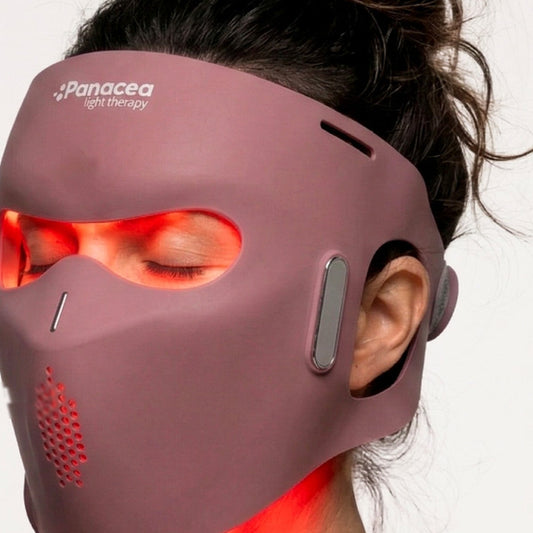

LED Masks and Light Intensity in mW/cm²: What the Numbers Really Mean
Share
An in-depth look at how we measure the Aurora LED mask, why direct skin contact requires different readings than a panel, and what the research says about the doses used in studies of cosmetic skin improvement.
Introduction
If you look around the world of LED light therapy, you see readings flying around everywhere. 100 mW/cm². 200 mW/cm². Sometimes even higher. The implicit message seems to be: the higher, the better.
But there is a problem: many of those numbers are not what they seem.
At Panacea Light Therapy, we have chosen to be honest about how we measure and what our readings mean. This means that our values may sometimes appear lower than those of some other brands. Not because our device performs less well, but because we test the device differently and more accurately.
In this blog, we explain:
- How we measure, and why this differs from what many other brands do
- Why an LED mask with direct skin contact requires very different doses from a panel at a distance
- What the research says about the doses described for cosmetic skin care
- What the Aurora mask is intended for—and what it is not
Spectrometer versus solar meter: why the measurement method determines everything
The solar meter: a popular but misleading instrument
Look through a number of red light therapy review channels on YouTube and you will consistently see the same little device: a handheld solar meter, often a TES-1333 or comparable model. The reviewer points it at a panel and presents the reading as though it were scientific truth.
The problem? Solar meters are not designed for LED light.
A solar meter works by adding up all incoming radiation between roughly 400 and 1100 nm into a single reading. The instrument is also calibrated for sunlight, a continuous, broad spectrum. When you point it at an LED, which emits a narrow peak at a specific wavelength, three things happen that artificially inflate the reading:
- Spectral sensitivity mismatch. A solar meter's sensor does not have the same sensitivity across its entire range. At some wavelengths, it "counts" twice as much. For sunlight, this averages out; for an LED peak at exactly that wavelength, the reading shoots up.
- It measures all radiation, including invisible radiation. Many "red" LED panels also produce near-infrared light. A solar meter adds it all together and gives one integrated reading. It makes it seem as though there is more "red light" than there actually is.
- Calibration for sunlight. Sunlight has a known intensity curve. LED light does not. The meter's factory calibration introduces a conversion factor that simply is not accurate for LEDs.
The result: solar meters typically give values for LED light that are 2 to 5 times higher than the actual effective intensity present at that specific wavelength. Scientific reviewers have written about this in the academic literature, emphasizing the importance of spectrometry over broadband measurements.
The spectrometer: what manufacturers and labs use
A spectrometer is a fundamentally different instrument. Instead of providing one total figure, it gives a curve: how much intensity is present at each individual nanometer? You can then read the output for each LED peak: at 633 nm there is X mW/cm², at 850 nm there is Y mW/cm², and at 1072 nm there is Z mW/cm².
Spectrometers are more expensive, more complex, and require expertise to use correctly, which is why you do not see them on YouTube. But they are the gold standard for manufacturers, scientific research, and regulatory bodies.
Our measurements of the Aurora mask were performed with a professional DHSP-3501RS spectrometer. The figures we share are the actual irradiances per wavelength that your skin receives.
What this means for you
When comparing brands, always ask: what instrument was this measured with?
If the answer is "solar meter", know that the numbers are probably flattering. If the answer is "spectrometer", you are comparing apples to apples.
Why direct skin contact requires different dosages
The Aurora mask is not a panel. That may seem obvious, but the implications for irradiance are often overlooked.
The inverse-square law for panels
With a red light therapy panel, you typically stand or sit 15 to 50 cm away. Light spreads in all directions, and intensity decreases with the square of the distance. A panel that emits 100 mW/cm² at the source may deliver only 25–40 mW/cm² to your skin at 20 cm. At 50 cm, only 5–10.
That is why panel values are often stated so high: they need the output to remain sufficient even at a distance.
A mask bypasses that entire problem
With the Aurora mask, the LED is 0 cm from your skin. No loss due to distance. What the LED emits, you receive 1-to-1.
That has three consequences:
- Lower source value is sufficient. A panel has to compensate for distance losses. A mask does not. The ~33 mW/cm² of red light we measure at the surface is the same 33 mW/cm² your skin receives. With a panel, you would need a much higher source value to achieve that irradiance on the skin.
- Higher source values become unsafe. If we placed 100 mW/cm² of red + NIR directly against your skin for 20 minutes, you would come dangerously close to thermal limits. NIR is largely converted into heat in the upper layers of the skin. With 100 mW/cm² in direct contact, you risk heat irritation, especially in sensitive areas such as under the eyes. Cosmetic LED masks are therefore generally designed with surface irradiances of 20-50 mW/cm² to remain within safe thermal limits.
- Consistent, uniform dose. With a panel, your position changes during a session: your head moves, shadows form, and some parts of your face receive more than others. The mask follows the contours of your face, so every square centimeter receives the same dose throughout the session.
So what is “enough”?
For cosmetic skincare, the research-based dose (irradiance × time, expressed in J/cm²) ranges from 4 to 30 J/cm² per session, depending on the specific application.
Calculate it for the Aurora mask during a 20-minute session at 100%:
- Red (33.9 mW/cm²) × 1200 sec / 1000 = 40.7 J/cm²
- Blue (18.9 mW/cm²) × 1200 sec / 1000 = 22.7 J/cm²
- NIR (12-19 mW/cm²) × 1200 sec / 1000 = 14.4 - 22.8 J/cm²
- Yellow (6.6 mW/cm²) × 1200 sec / 1000 = 7.9 J/cm²
All within, or even well within, the range described in research.
What science says about the wavelengths in the Aurora mask
Each wavelength in the mask was selected based on peer-reviewed research into cosmetic skincare. An overview is provided below.
Blue (415 nm): blemishes and skin balance
Blue light around 415 nm has been studied for its effect on acne for twenty years. Its action is photochemical: Cutibacterium acnes (formerly Propionibacterium acnes), the bacterium involved in acne inflammation, produces porphyrins. When these porphyrins absorb blue light, reactive oxygen species are generated, disrupting the bacterium from within.
Research by Papageorgiou and colleagues (2000) in the British Journal of Dermatology described how regular blue-light application in people with mild to moderate acne was associated with fewer inflammatory lesions, with the clearest outcomes seen with combined blue and red light used regularly over several weeks. Later reviews by Ash and colleagues (2017) in Lasers in Medical Science described the relevance of wavelength selection for light penetration and efficacy.
Our 19 mW/cm² × 20 min = ~23 J/cm² per session is well within the range described in research (15–50 J/cm² for blue light in acne studies).
Yellow (590 nm): evening skin tone and visible redness
Yellow light around 590 nm is less well known, but is used to support an even complexion and reduce the visibility of superficial redness. Its proposed action is related to the modulation of inflammatory processes in the upper layers of the skin.
Recent laboratory research by Hong and colleagues (2022) in Experimental Dermatology described how 590 nm yellow LED exposure reduced oxidative stress in skin cells and may modulate UVB-induced changes in fibroblasts, providing a possible explanation for the reported effects on skin texture and visible redness.
Due to the natural physical limitation of yellow LEDs (the “green-yellow gap” in semiconductor technology), yellow LED output is always lower than red. This is a fundamental property of how LEDs are made for specific wavelengths, not a difference in quality. Our 6.6 mW/cm² × 20 min = ~7.9 J/cm² falls within the range used in studies with cosmetic outcomes.
Red (633 nm): collagen and skin structure
This is by far the most extensively studied wavelength in LED skin therapy. Red light between 620 and 660 nm is absorbed by mitochondrial enzymes, particularly cytochrome c oxidase, leading to increased ATP production and stimulated fibroblast activity. Fibroblasts are the cells that produce collagen and elastin.
Wunsch and Matuschka published a controlled study in Photomedicine and Laser Surgery in 2014 in which two groups received sessions with red and near-infrared light over 30 sessions across 15 weeks. In both groups, the researchers reported improvements in skin radiance, the appearance of wrinkles, and collagen density measured by ultrasound.
Earlier studies described similar outcomes with LED sources at red wavelengths, including Lee and colleagues (2007) in the Journal of Photochemistry and Photobiology B and Russell and colleagues (2005) in the Journal of Cosmetic and Laser Therapy. The doses used ranged from 4 to 60 J/cm² per session.
Our 40.7 J/cm² is well within this range.
Near-infrared (850 nm): deeper support for cellular energy
850 nm penetrates deeper than red light (typically up to 1–2 mm into the skin, compared with 0.5–1 mm for 633 nm red light). It works through the same mitochondrial mechanisms but reaches deeper fibroblasts and cells. An extensive overview of these mechanisms can be found in Avci and colleagues (2013) in Seminars in Cutaneous Medicine and Surgery and Hamblin (2017) in AIMS Biophysics.
The Aurora mask contains 850 nm in 78 of the 90 LED packages, combined with red light. In Anti-Aging and Total Care modes, both wavelengths work synergistically. Research suggests that the combination delivers more than either one alone because they target different skin layers.
Near-infrared (1072 nm): targeted at the eye contour
This is a less commonly used wavelength, but an interesting one. Research has examined 1072 nm specifically for the delicate skin around the eyes, where it is thought to support microcirculation and skin quality. The original work was conducted using low-level laser and LED sources.
The Aurora mask contains 12 of its 90 LEDs equipped with 1072 nm, concentrated below and around the eyes. This corresponds to ~13% of the mask’s IR output. The dosage here is intentionally low; the skin around the eyes is thin and sensitive, and higher intensities would be undesirable.
What the Aurora mask does NOT do
Honesty works both ways. The mask is an excellent cosmetic device, but there are things it is not intended for.
Not for deep pain or large muscle groups
Support for pain-related complaints through red/NIR light has been extensively described in research for joints, muscles, and tissues located a few centimeters deep. However, this requires higher source intensities and larger treatment areas, typically panels. The Aurora mask works on skin layers a few millimeters deep, not on joints or deeper muscles.
For pain relief and recovery, choose a panel from the Panacea range.
May help with: superficial facial pain
Some users report greater comfort from superficial facial pain, jaw tension, or mild sinus-related skin irritation while using the mask. This is plausible because red and NIR light reaches the upper layers where these sensations often occur. We do not claim this as its primary function, but it is a welcome side effect for some users.
Not a substitute for medical care
For severe acne, rosacea, eczema, or other skin conditions, the first step should always be to consult a dermatologist. The Aurora mask is a supportive cosmetic device, not a medical device.
How does this translate into results?
Cosmetic LED therapy works cumulatively. A single session does not produce a lasting effect. Effects described in research usually become visible only with regular use over several weeks to months (3–5 sessions per week of 10–20 minutes). An overview of LED applications in dermatology can be found in Barolet (2008) in Seminars in Cutaneous Medicine and Surgery.
What to realistically expect:
- In the first few weeks: the skin may feel smoother, with a subtle glow and less visible redness.
- With continued regular use: improved skin texture, less visible mild acne spots (when using Anti-Acne mode), and a more even complexion.
- Over the longer term: softer lines, firmer-feeling skin, and improved overall skin quality.
Results vary from person to person. Factors such as age, skin type, lifestyle, and consistency of use all play a role.
Conclusion
In a market where mW/cm² figures are often strategically manipulated to sound more impressive, we choose to be honest.
Our values:
- Measured with a spectrometer, not a solar meter.
- Measured at the LED surface, reflecting what your skin actually receives.
- Carefully dosed for safe and comfortable direct skin contact.
- Within the range described in research for cosmetic skincare.
The Aurora mask is not a “more is better” device. It is a precision instrument with the right dose for what it is designed to do: support your skin safely, consistently, and based on research.
If you have questions about the specific measurements, the test report, or which mode best suits your skin goals, please contact us via info@panacearedlight.comWe prefer complete answers to inflated figures.
Scientific references
The studies below form the basis for our choices regarding wavelengths and dosages. This list is not exhaustive; the literature on photobiomodulation is growing rapidly.
- Papageorgiou, P., Katsambas, A., & Chu, A. (2000). Phototherapy with blue (415 nm) and red (660 nm) light in the treatment of acne vulgaris. British Journal of Dermatology, 142(5), 973-978. PubMed
- Wunsch, A., & Matuschka, K. (2014). A controlled trial to determine the efficacy of red and near-infrared light treatment in patient satisfaction, reduction of fine lines, wrinkles, skin roughness, and intradermal collagen density increase. Photomedicine and Laser Surgery, 32(2), 93-100. PubMed
- Lee, S. Y., Park, K. H., Choi, J. W., et al. (2007). A prospective, randomized, placebo-controlled, double-blinded, and split-face clinical study on LED phototherapy for skin rejuvenation. Journal of Photochemistry and Photobiology B: Biology, 88(1), 51-67. PubMed
- Russell, B. A., Kellett, N., & Reilly, L. R. (2005). A study to determine the efficacy of combination LED light therapy (633 nm and 830 nm) in facial skin rejuvenation. Journal of Cosmetic and Laser Therapy, 7(3-4), 196-200. PubMed
- Avci, P., Gupta, A., Sadasivam, M., et al. (2013). Low-level laser (light) therapy (LLLT) in skin: stimulating, healing, restoring. Seminars in Cutaneous Medicine and Surgery, 32(1), 41-52. PubMed
- Hong, S. R., Lee, J. M., Lim, H. W., et al. (2022). Irradiation with 590-nm yellow light-emitting diode light attenuates oxidative stress and modulates UVB-induced change of dermal fibroblasts. Experimental Dermatology, 31(6), 931-940. PubMed
- Ash, C., Dubec, M., Donne, K., & Bashford, T. (2017). Effect of wavelength and beam width on penetration in light-tissue interaction using computational methods. Lasers in Medical Science, 32(8), 1909-1918. PubMed
- Hamblin, M. R. (2017). Mechanisms and applications of the anti-inflammatory effects of photobiomodulation. AIMS Biophysics, 4(3), 337-361. Full text on PMC
- Calderhead, R. G. (2007). The photobiological basics behind light-emitting diode (LED) phototherapy. Laser Therapy, 16(2), 97-108. Full text on J-Stage
- Barolet, D. (2008). Light-emitting diodes (LEDs) in dermatology. Seminars in Cutaneous Medicine and Surgery, 27(4), 227-238. PubMed
Red light therapy is a wellness application and not a substitute for medical care. Results vary from person to person; consult your doctor if you have any concerns.