


Does an LED mask work? Everything you need to know in 2026
Share
LED masks are now an integral part of your social media feed. Beauty influencers swear by them, dermatologists are investigating how they work, and the technology behind these masks has accelerated rapidly in recent years. But what exactly do LED masks do for your skin? And perhaps more importantly: what should you look for when buying one in 2026?
In this article, we explain how modern LED masks work, what scientific evidence supports their effects, and why the latest generation (such as the Panacea Aurora LED mask) represents a leap forward compared with what was available on the market until recently.
How does an LED mask work?
An LED mask illuminates your skin with specific colors of light. Each color has its own wavelength (expressed in nanometers, nm) and penetrates the skin to a different depth. There, the light stimulates your skin cells to support their natural processes: collagen production, circulation, recovery, and the reduction of inflammatory responses.
The four—and, in modern masks, five—main light colors:
Blue light (415 nm). Works on the skin's surface and targets acne-causing bacteria. Helps with blemishes and calms active skin.
Yellow light (590 nm). Supports skin balance, helps reduce visible redness, and contributes to a more even complexion.
Red light (633 nm). Stimulates fibroblasts and the production of collagen and elastin. It is the best-known wavelength for anti-aging, skin texture, and firmness.
Near-infrared 850 nm. Penetrates more deeply than visible light and supports cellular energy processes (ATP). Helps with recovery, circulation, and firmness at a deeper level.
Near-infrared 1072 nm. A specialized wavelength that primarily targets the delicate area around the eyes. Supports microcirculation and helps soften fine lines.
The latter, 1072 nm specifically for the eye area, is a relatively new addition to consumer masks. Standard masks usually stop at 850 nm.
What does the science say?
LED light therapy is not an unsubstantiated wellness claim. There is now a solid body of scientific research:
Acne
- A 2021 systematic review describes that blue LED light may help reduce inflamed acne.
- A 2022 randomized study describes how both red and blue light can reduce mild to moderate acne, with red light generally being well tolerated.
Anti-aging and skin texture
- 2023 research: According to this study, red LED light stimulates collagen production, reduces wrinkles and fine lines, and gives the skin a more radiant appearance. In that study, the effect persisted for some time after treatment stopped.
- A 2023 systematic review and meta-analysis describes the skin-rejuvenating effects of yellow and near-infrared light.
Skin healing
- A 2022 randomized study describes how red LED light supports the skin's natural healing process by modulating inflammatory cells and promoting fibroblast activity.
Specific skin conditions
- The same meta-analysis describes red and blue light as supportive treatments for acne vulgaris and other inflammation-prone skin conditions, thanks to their anti-inflammatory effects.
- A 2022 systematic review points to the anti-inflammatory and immune-modulating effects of LED therapy for rosacea.
In short: the effects of LED light on the skin have been studied and described in multiple studies. The quality of the mask (wavelength precision, number of LEDs, light intensity, and fit) then determines whether you actually experience those effects at home.
What has changed? The next generation of LED masks
The first generation of consumer LED masks often used 2 or 3 light colors, a fixed intensity, and a one-size-fits-all program. The latest generation, which includes the Panacea Aurora, differs in several fundamental ways:
- More wavelengths in one device. Five wavelengths instead of three, including the specific 1072 nm wavelength for the eye area.
- Preconfigured programs. No turning colors on and off individually, but research-based combinations for each skin goal.
- Adjustable intensity. 50%, 75%, or 100%, so you can build up gradually.
- Décolleté extension. The décolleté is a blind spot with many masks, even though it is a sensitive area when it comes to sun damage and skin aging.
- Lighter and wireless. USB-C, a rechargeable battery, medical-grade silicone, and no cables getting in the way.
- EMF and certification documentation. Serious brands have their masks tested for electromagnetic radiation and CE compliance. Ask for the documentation if in doubt.
What should you look for when buying an LED mask?
The LED mask market is flooded with cheap alternatives. They often look identical in product photos, but the differences are in details your skin really notices.
Wavelengths and their precision. Effective wavelengths fall within fairly narrow ranges: blue 415 to 440 nm, yellow 590 to 595 nm, red 630 to 680 nm, near-infrared 800 to 1100 nm. A brand that communicates the exact wavelengths takes its product seriously.
Number of LEDs and their placement. It’s not just the total number that matters, but also how the LEDs are distributed across the different areas of the face. A mask that places all its LEDs on the forehead and few around the eyes or jaw won’t work evenly.
Material and fit. Medical-grade silicone conforms to the shape of your face and is hygienic to clean. Hard plastic presses on sensitive areas and fits poorly.
Safety and certification. Look for CE and RoHS marking. A serious brand publishes EMF test reports and can explain why its mask is safe to wear directly on your face for extended periods.
Ease of use. Wireless USB-C charging, a built-in timer, adjustable intensity, and a lightweight design make the difference between “that mask I always look forward to using” and “that mask sitting in the drawer.”
Reviews and customer service. Read verified reviews and actively look for negative experiences. How does the brand handle returns, warranties, and questions? A two-year warranty is a sign of confidence.
The Panacea Aurora LED mask: the next step
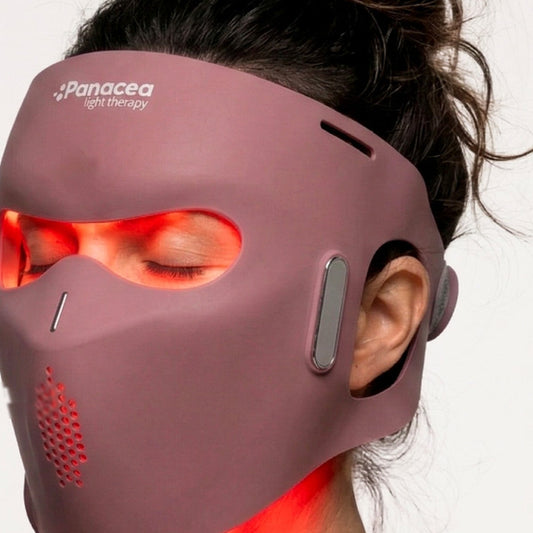
The Panacea Aurora LED Mask is our most advanced version yet and is designed around insights from years of research and feedback from users of earlier models.
What sets the Aurora apart:
- 90 LEDs in the face section and 57 LEDs in the optional décolleté section. For even, uniform illumination of both the face and décolleté.
- Five wavelengths: 415 nm (blue), 590 nm (yellow), 633 nm (red), 850 nm (NIR), and 1072 nm (NIR), with 1072 nm positioned specifically under the eyes for the most delicate skin area.
- Six pre-programmed programs: Collagen Boost, Skin Quality, Anti-Aging, Total Care, Anti-Acne, and Redness Relief. One press of a button, no fiddling required.
- Adjustable intensity (50% / 75% / 100%) and timer of 10, 15, or 20 minutes.
- Medical-grade silicone with adjustable straps, just 6 mm thick, and wireless to use.
- USB-C rechargeable, with a 4000 mAh battery (face) or 5000 mAh (face + décolleté).
- 2-year warranty from the delivery date.
While the old Panacea Red Light mask was already a highly regarded all-rounder, the Aurora brings five key improvements: a specific wavelength for the eye area, pre-programmed programs based on skin goals, an expandable décolleté section, adjustable intensity, and an even lighter and more comfortable fit.
View the Panacea Aurora LED mask →
How do you use the Aurora mask?
For the best results, consistency is more important than the duration or intensity of each session. The routine below is a good starting point:
- Clean and dry your skin. Remove makeup and sunscreen completely.
- Put on the mask and adjust the adjustable straps for a comfortable fit.
- Press and hold the power button for 3 seconds to turn on the device.
- Choose a program by briefly pressing the power button (Collagen Boost, Anti-Acne, Anti-Aging, etc.).
- Adjust the intensity. Start at 50% during your first sessions and gradually increase it afterward.
- Set the timer to 10, 15, or 20 minutes. The mask switches off automatically.
- Hydrate after the session with a serum or cream of your choice.
How often? Three to four times a week, 15 to 20 minutes per session. Users often report effects on skin tone and radiance first, after regular use over several weeks; collagen production and firmness require longer, consistent use. Results vary from person to person.
Tip: ease it into your existing skincare routine. LED light supports circulation and cellular activity, which may help your serums and moisturizers absorb better afterward.
Frequently asked questions
Is an LED mask safe?
When used according to the instructions, LED light is generally well tolerated. LED light is non-thermal and contains no UV. Exercise caution if you are photosensitive, taking certain medications (such as isotretinoin), or have certain skin conditions. In that case, consult a general practitioner or skin therapist first.
When will I see results?
Don't expect a change after just one session. Effects on radiance and skin tone are often reported first, after regular use over several weeks; effects on wrinkles and firmness require longer, consistent use. Results vary from person to person.
Can I combine the Aurora mask with retinol or acids?
Yes, but use them at different times. Have your LED session in the morning or early evening, and apply your active products afterward or on other days.
Is the décolleté extension necessary?
Not required. But because the décolleté often lags behind facial skincare when it comes to skin aging, it is a valuable addition if you also want to include that area.
Ready to experience it for yourself?
LED light therapy is no longer a hype. It is a research-backed addition to your skincare routine. A good-quality mask, used regularly, can be a valuable at-home addition to what was previously only possible in a salon.
With the Panacea Aurora LED mask, you bring that quality into your own bathroom: five wavelengths, six preprogrammed programs, adjustable intensity, and a design you will actually want to keep using.
Discover the Panacea Aurora LED mask →
Do you have questions about which mask is right for your skin goals? Our customer service team is happy to help: info@panacearedlight.com
Red light therapy is a wellness application and not a substitute for medical care. Results vary from person to person; consult your doctor if you have any concerns.



1 comment
Ik heb net het masker gekocht maar kan ik deze ook gebruiken tijdens de zwangerschap?